

Workforce Stability Is Institutional Stability
Institutional effectiveness depends on more than policies, procedures, technology, and strategic plans. It depends on the people responsible for implementing them and the organizational conditions in which they work.
Employee satisfaction, work engagement, workload, communication, leadership support, and role clarity can influence operational consistency, student retention, regulatory compliance, and institutional performance. When these conditions deteriorate, the consequences may extend well beyond individual departments, creating institutional risks that traditional performance metrics do not always capture.
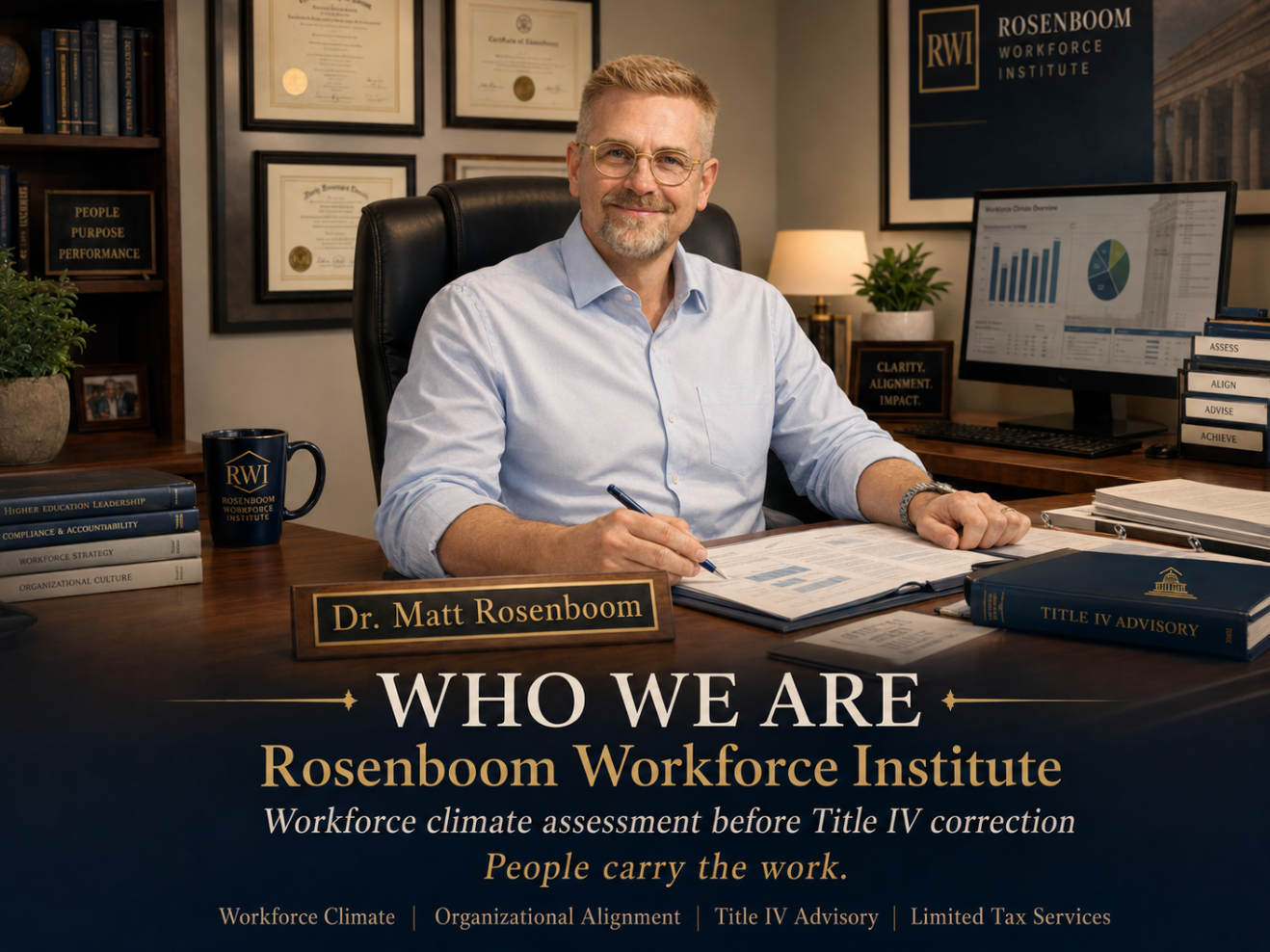
Rosenboom Workforce Institute helps colleges and universities identify, understand, and address the workforce and organizational conditions that influence institutional stability, operational effectiveness, and long-term sustainability.
Through research-informed workforce assessments, institutional advisory services, and cross-functional operational analysis, the Institute helps institutional leaders look beyond visible symptoms to better understand the conditions contributing to organizational challenges.
Because institutional improvement begins with understanding the people, processes, and relationships responsible for moving the mission forward.
Workforce Climate Snapshot
Understanding Workforce Conditions Before They Become Institutional Risks
Institutions routinely evaluate enrollment, student retention, financial performance, compliance, and academic outcomes. Yet the workforce conditions influencing those outcomes often receive considerably less systematic attention.
The Workforce Climate Snapshot provides colleges and universities with a focused, research-informed assessment of the organizational conditions experienced by their employees.
Designed as an accessible starting point for institutional workforce evaluation, the Snapshot examines six foundational dimensions:
Employee Satisfaction: How employees perceive their work environment, responsibilities, and overall employment experience.
Work Engagement: The degree of connection, commitment, and involvement employees experience in their work.
Workload: Employee perceptions of workload demands, available resources, and operational expectations.
Communication: The clarity, consistency, and effectiveness of organizational communication.
Organizational Support: The extent to which employees perceive institutional leadership and organizational systems as supportive.
Role Clarity: How clearly employees understand their responsibilities, expectations, and areas of accountability.
What Institutions Receive
Participating institutions receive a standardized analysis and a concise findings report identifying workforce strengths, emerging concerns, and areas that may warrant further institutional examination.
The Snapshot is intentionally designed to provide meaningful baseline insight without the time or financial commitment associated with a comprehensive organizational assessment.
It does not include executive consultation, individualized institutional improvement plans, extensive customized recommendations, interviews, focus groups, or in-depth organizational analysis.
From Workforce Awareness to Institutional Understanding
For institutions seeking deeper examination of workforce conditions, organizational relationships, leadership practices, and operational consequences, Rosenboom Workforce Institute also offers a Comprehensive Workforce Climate Assessment.
Together, these services provide institutions with different levels of workforce insight based on their organizational needs, available resources, and desired depth of analysis.
Why Workforce Climate Matters
Colleges and universities invest substantial resources in student success, enrollment growth, regulatory compliance, technology, strategic planning, and operational improvement. Yet the effectiveness of those investments ultimately depends on the employees who implement institutional priorities.
An institution can have well-designed policies, sophisticated technology, and clearly articulated strategic objectives while still experiencing operational challenges rooted in workforce conditions.
Employee dissatisfaction, declining engagement, excessive workloads, unclear responsibilities, and inconsistent communication do not always produce immediate or easily identifiable institutional failures. Instead, their consequences may develop gradually through increased employee turnover, inconsistent service delivery, delayed processes, departmental friction, and reduced operational continuity.
These challenges become particularly significant when responsibilities cross departmental boundaries.
Admissions, Financial Aid, Academic Affairs, Student Accounts, the Registrar, and Student Services may each perform their responsibilities while institutional processes still break down in communication, coordination, or accountability.
Traditional institutional metrics frequently measure the outcomes of these processes without examining the workforce conditions contributing to them.
Workforce climate assessment provides institutional leaders with another dimension of organizational intelligence.
By systematically examining employee experiences and organizational conditions, institutions can identify emerging concerns, better understand operational vulnerabilities, and make more informed decisions about workforce support, organizational improvement, and institutional sustainability.
Not every institutional problem originates with the workforce. However, workforce conditions can influence whether institutional strategies succeed, whether operational improvements are sustained, and whether emerging risks are recognized before they become more consequential.
The objective is not simply to measure employee satisfaction. It is to better understand how the institutional environment influences the people responsible for fulfilling the institution's mission.
Published Works & Institutional Insights
Extending the Conversation Beyond Consulting
The work of Rosenboom Workforce Institute extends beyond institutional assessments and advisory engagements.
Through published books on higher-education operations, institutional alignment, regulatory compliance, workforce behavior, and organizational leadership, Dr. Matthew E. Rosenboom shares insights from more than 25 years of professional experience and doctoral research.
These publications explore challenges institutional leaders face every day, including the link between workforce conditions and operational effectiveness, the consequences of unclear departmental accountability, and organizational risks that can develop long before they appear in traditional performance metrics.
Written for higher-education professionals, institutional leaders, consultants, and others interested in organizational effectiveness, these works complement the Institute's research-informed approach.
Explore Our Books and Professional Development Resources
Discover published titles, explore institutional perspectives, and access available purchasing options through our dedicated Books and Professional Development page.
Research-Informed. Higher-Education Focused.
Rosenboom Workforce Institute was founded by Dr. Matthew E. Rosenboom, whose professional background combines more than 25 years of higher-education experience with doctoral research examining the relationships among job satisfaction, work engagement, and counterproductive work behavior among college and university employees.
This combination of operational experience and academic research informs the Institute's approach to workforce assessment, organizational analysis, and institutional advisory services.
Rather than examining workforce concerns in isolation, the Institute considers how organizational conditions, departmental responsibilities, leadership practices, and institutional processes interact to influence performance.
The objective is to help institutional leaders move beyond assumptions and make more informed decisions grounded in research, organizational evidence, and an understanding of higher-education operations.
Start the Conversation
Institutional challenges rarely exist in isolation. Workforce conditions, operational processes, departmental relationships, and leadership decisions can interact in ways that influence institutional effectiveness and long-term stability.
Whether your institution is considering a Workforce Climate Snapshot, a Comprehensive Workforce Climate Assessment, or a broader institutional advisory engagement, Rosenboom Workforce Institute welcomes the opportunity to discuss your organization's needs.
The Institute also welcomes conversations with higher-education consulting organizations interested in collaboration, specialized workforce assessment capabilities, and institutional advisory partnerships.
Contact Rosenboom Workforce Institute
Email: drmattrosenboom@rosenboomtaxandadvisory.com
Phone: 629-215-5816
Connect on LinkedIn
Contact us
Interested in working together? Fill out some info and we will be in touch shortly. We can’t wait to hear from you!