

Workforce Assessment & Advisory Services
Three levels of support designed to help institutions measure workforce conditions, understand what the findings mean, and determine what comes next.
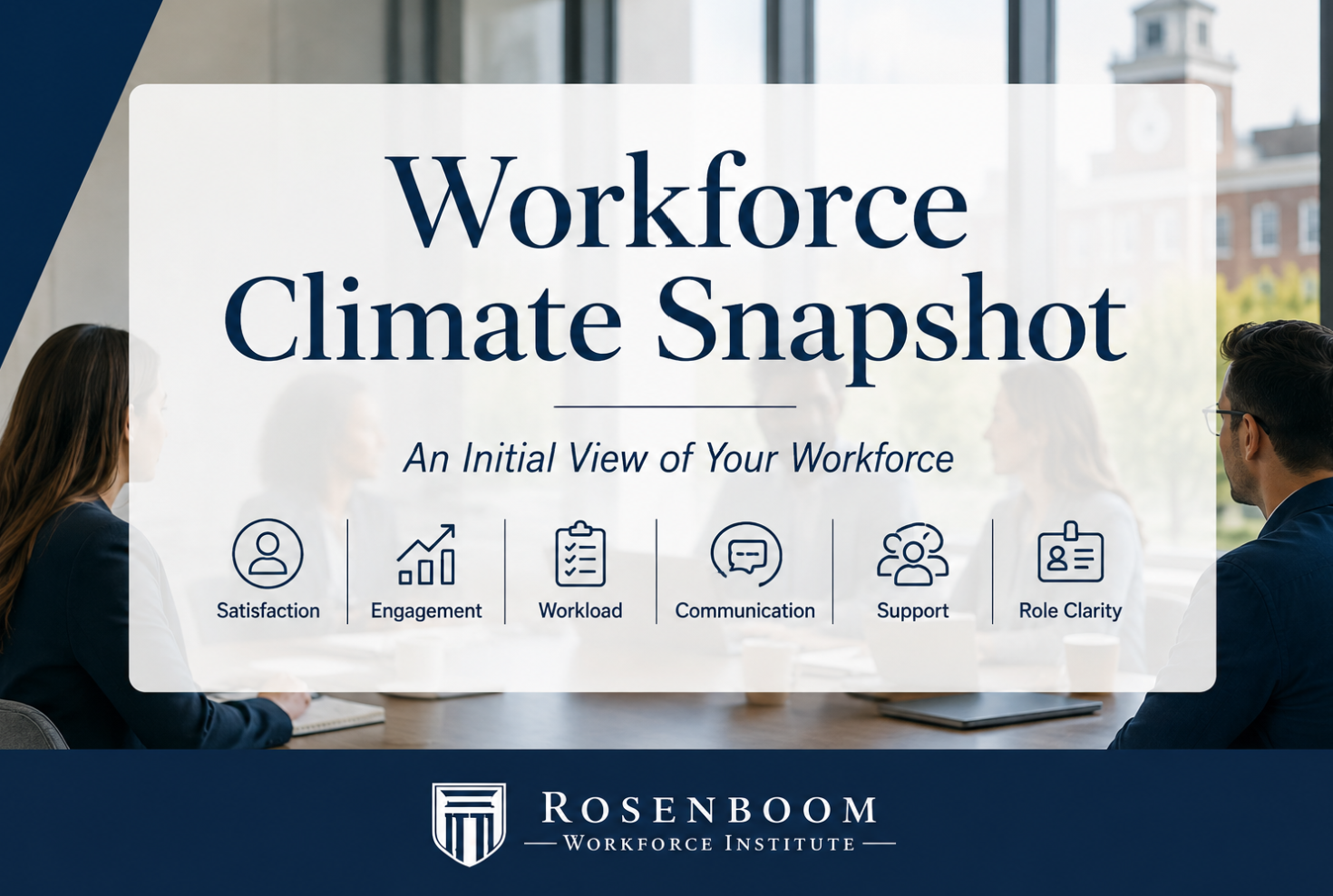
A focused, research-informed assessment designed to give colleges and universities an initial view of key workforce conditions. The Snapshot examines employee satisfaction, work engagement, workload, communication, organizational support, and role clarity.
Institutions receive standardized workforce measurement, key-indicator analysis, and a concise findings report highlighting notable strengths and areas that may warrant additional attention. This streamlined option does not include executive debriefing, customized recommendations, interviews, focus groups, or deeper organizational analysis.
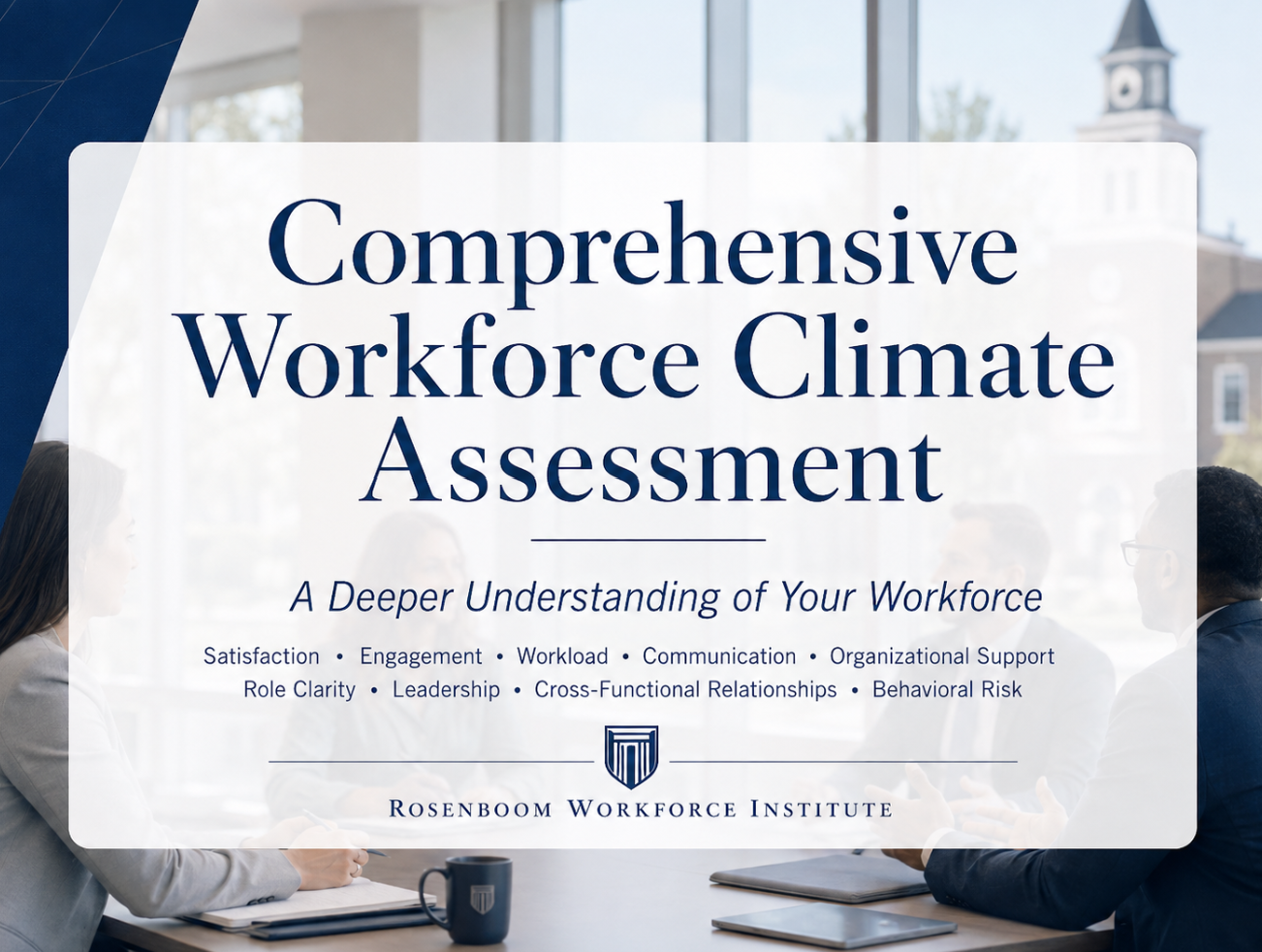
A deeper, research-informed assessment designed for colleges and universities seeking a fuller understanding of the workforce conditions influencing institutional performance. The Comprehensive Workforce Climate Assessment examines employee satisfaction, work engagement, workload, communication, organizational support, role clarity, leadership conditions, cross-functional relationships, and behavioral risk.
Institutions receive expanded analysis, deeper interpretation of findings, customized recommendations, and leadership-level insight designed to help identify both workforce strengths and organizational conditions that may require attention. Scope and pricing are customized based on institutional size, complexity, and assessment needs.
Custom engagement based on institutional size and scope
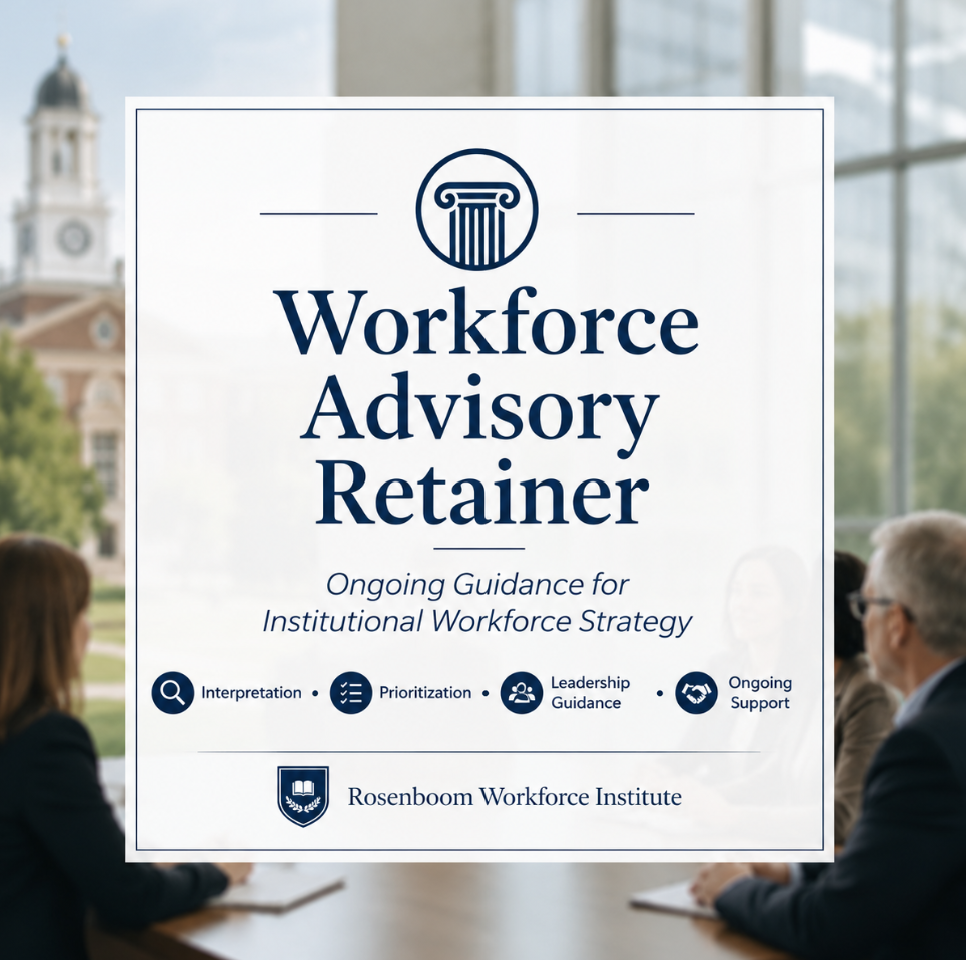
An ongoing advisory engagement for colleges and universities that want continued support in understanding and responding to workforce climate findings. The Workforce Advisory Retainer provides leadership with ongoing guidance related to employee satisfaction, engagement, workload, communication, organizational support, role clarity, and broader organizational conditions affecting institutional performance.
This service is designed for institutions that want help interpreting findings over time, discussing emerging concerns, identifying priorities, and considering practical next steps as workforce conditions evolve. Scope is customized based on institutional needs and the level of ongoing advisory support requested.
Sometimes the best way to understand an operation is to work inside it.
Traditional workforce assessments provide valuable insight through data, interviews, surveys, document review, and observation. But some organizational conditions are difficult to fully understand from the outside.
The Embedded Workforce & Operations Assessment provides another option.
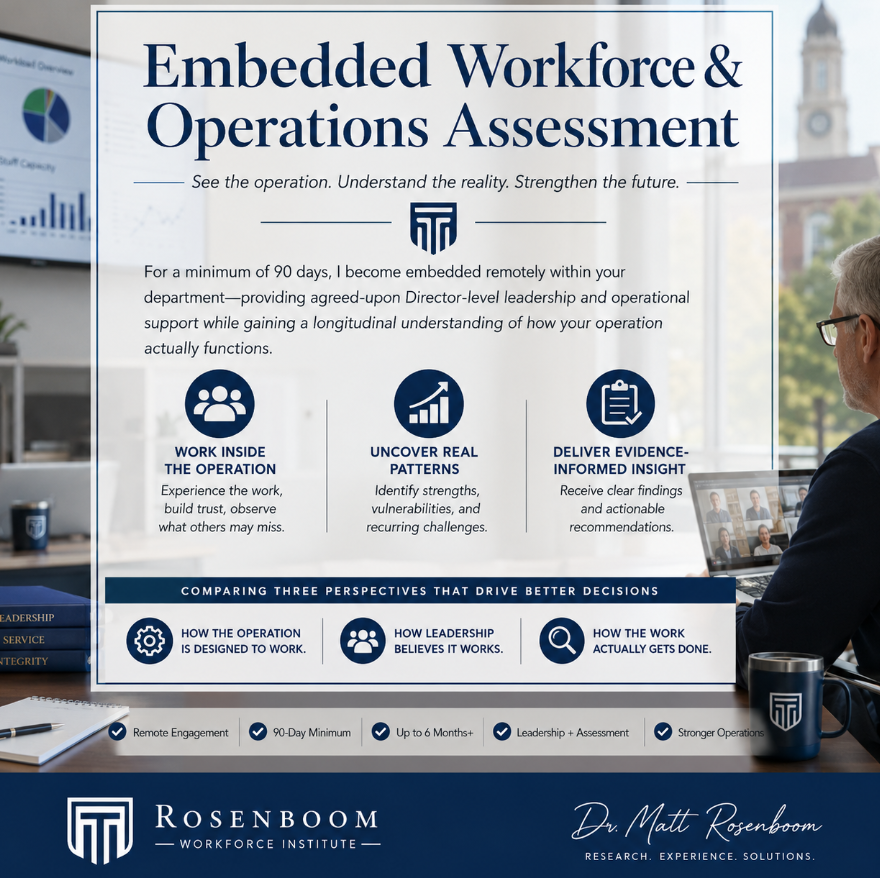
For a minimum of 90 days, I become embedded remotely within the department, providing agreed-upon Director-level leadership and operational support while simultaneously developing a longitudinal understanding of how the organization actually functions.
This is more than interim staffing.
Working alongside the team provides an opportunity to experience the operation across multiple cycles and observe the realities that may not become visible during a traditional point-in-time review. Over time, working relationships develop, employees become more comfortable discussing the challenges they encounter, and recurring patterns become easier to distinguish from isolated events.
The assessment can examine areas including staffing capacity, workload, employee engagement, role clarity, knowledge concentration, cross-training, process ownership, leadership support, communication, departmental handoffs, cross-functional relationships, informal workarounds, and operational pressure points.
Most importantly, the embedded approach creates an opportunity to compare three perspectives:
How the operation is designed to work.
How leadership believes it works.
How the work actually gets done.
Why a 90-Day Minimum?
Meaningful organizational patterns rarely reveal themselves in a few meetings.
The first several weeks allow me to learn the operation, understand responsibilities, and establish working relationships. As the engagement progresses, I can observe recurring processes, deadlines, interactions, challenges, and responses to operational pressure.
That longitudinal perspective provides something a brief review cannot easily replicate:
I don't simply ask how the operation works. I experience it.
What the Institution Receives
Throughout the engagement, the institution receives the agreed-upon remote leadership or operational support needed by the department.
At the conclusion, institutional leadership receives an evidence-informed assessment of the workforce and operational environment, identifying observed strengths, vulnerabilities, organizational risks, recurring patterns, and recommendations for strengthening internal capacity and operational sustainability.
Where findings indicate that additional investigation is warranted, a Full Workforce Climate Assessment may be recommended.
Who Is This For?
The Embedded Workforce & Operations Assessment may be particularly valuable for institutions experiencing:
Leadership vacancies or transitions
Persistent turnover or staffing instability
Processing backlogs or recurring operational problems
Compliance concerns without an obvious root cause
Heavy dependence on one or two key employees
Cross-functional or communication problems
Repeated attempts at improvement that have not produced sustainable results
A desire to understand the department before restructuring or making significant staffing decisions
Engagement Structure
Minimum engagement: 90 days
Extended engagement: Up to six months or longer when appropriate
Delivery: Remote
Institutions needing only temporary operational coverage may engage me for interim support separately. The Embedded Workforce & Operations Assessment is designed for institutions that want something more:
Immediate operational support today—and a much deeper understanding of the workforce and organizational conditions affecting tomorrow.