


Better Together: A New Approach to Group Professional Development in Higher Education
What happens when professional development becomes something an entire department experiences together? Introducing Better Together, a new series from Rosenboom Workforce Institute designed to help higher education teams strengthen communication, collaboration, employee engagement, and everyday effectiveness through structured group learning, realistic scenarios, and practical activities.

The Value of Shared Experience: Why I Am Building a Library of Practical Professional Development Workbooks
The Rosenboom Workforce Institute's growing professional development workbook library is built on a simple belief: no one has all the answers, and meaningful learning comes from sharing experiences and perspectives. Drawing on more than 25 years in higher education, Dr. Matthew Rosenboom reflects on the value of practical resources that encourage thoughtful discussion, collaboration, and continuous improvement. Each workbook offers an opportunity to learn from one another, build upon existing strengths, and discover approaches that support employees, institutions, and students.

The Right Professional Development Resource for the Problem You're Actually Facing
Professional development in higher education requires more than regulatory knowledge. Explore how Rosenboom Workforce Institute's 28 published books and workbooks can help Financial Aid Advisors, directors, supervisors, and institutional leaders address compliance challenges, strengthen communication, improve workplace relationships, and support institutional effectiveness. Plus, a preview of an upcoming collection focused on essential professional and leadership skills.
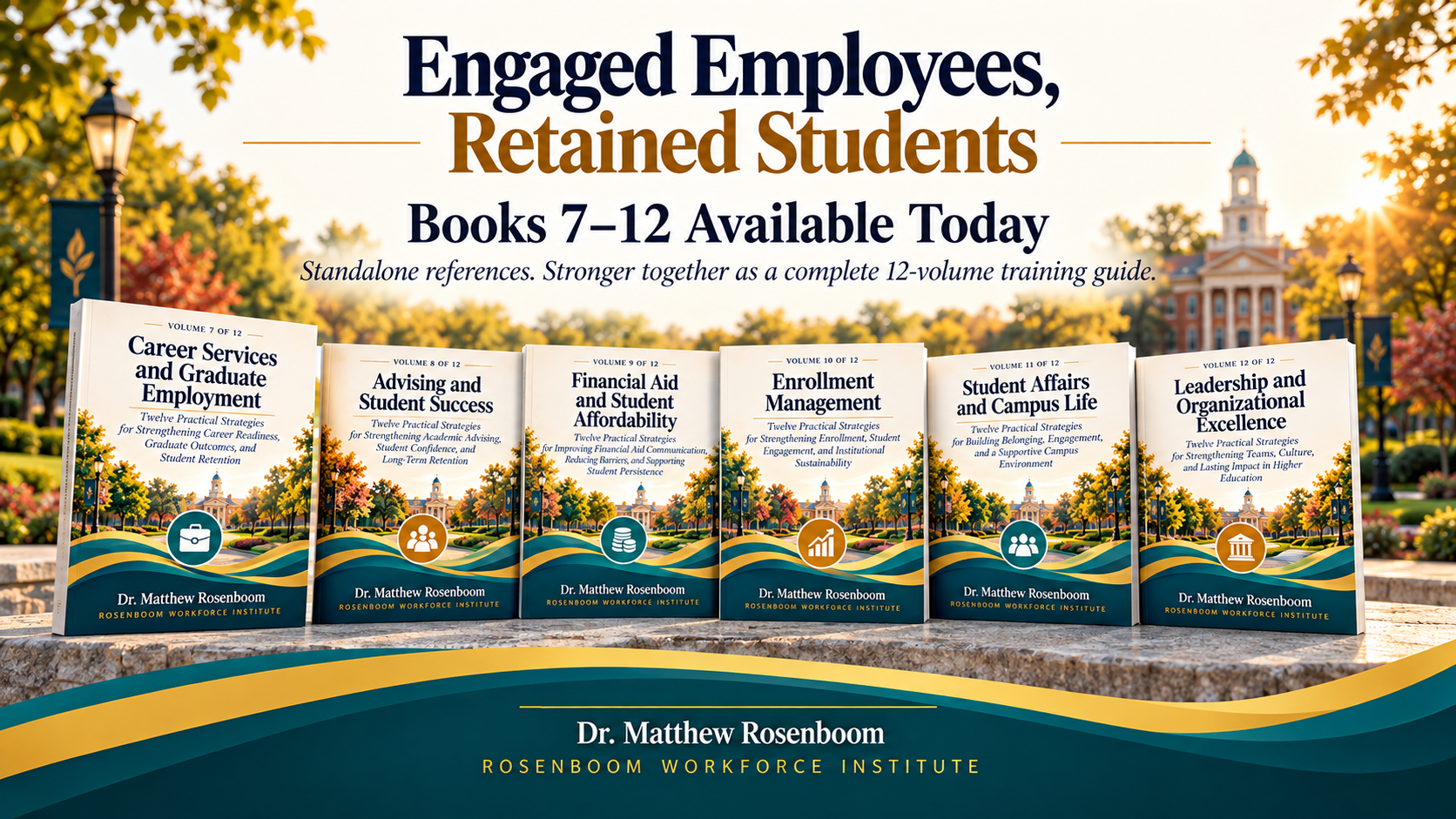
Engaged Employees, Retained Students: Building Stronger Institutions, One Department at a Time
The Rosenboom Workforce Institute is completing its 12-volume Engaged Employees, Retained Students professional development series, with Books 7–12 scheduled for release today, October 21, 2026. Each workbook provides practical scenarios, exercises, and strategies to strengthen employee engagement, institutional collaboration, and student retention. While each volume can serve as a standalone departmental reference, the complete collection is designed to function as a comprehensive institutional training and reference guide. Discover how supporting employees across every department can contribute to stronger student experiences and lasting institutional improvement.

When Interim Financial Aid Leadership Becomes the Control When Leadership Leaves, Compliance Risk Does Not Pause
Interim Financial Aid leadership is not just vacancy coverage. When an institution is facing leadership disruption, compliance pressure, staff uncertainty, documentation gaps, or unclear decision authority, interim leadership can become a critical internal control. This article explains when a Financial Aid leadership vacancy becomes a control gap and why institutions must stabilize risk before operational drift becomes a compliance, student service, or institutional credibility issue.

The First 30 Days After Financial Aid Leadership Changes Are the Most Dangerous
The first 30 days after a Financial Aid leadership change can be the most dangerous period operationally. When decision authority is unclear, institutional memory is undocumented, and staff lack direction, compliance risk can grow quickly. This article explains why institutions need a stabilization plan immediately after leadership disruption, including ownership clarity, deadline monitoring, documentation review, staff support, cross-department communication, and executive visibility before operational drift becomes a compliance problem.

When Leadership Leaves, Compliance Risk Does Not Pause
Leadership vacancies do not pause Title IV obligations. When a Financial Aid Director resigns, takes leave, is terminated, or when an institution faces heightened compliance pressure, students still need aid processed, disbursements reviewed, reconciliations completed, SAP decisions made, and R2T4 calculations handled. This article explains why Interim Financial Aid Leadership provides operational stabilization, executive-level direction, compliance oversight, and continuity support when institutions cannot afford drift.

Moving From Succession Awareness to Action in Financial Aid Operations
Succession risk in Financial Aid is not solved by replacing a person after they leave. It is reduced by building an operation that can continue functioning when people change. This article explains how institutions can move from awareness to action through workload mapping, process documentation, cross-training, role clarity, leadership visibility, and continuity planning. Strong Financial Aid operations do not depend on one person’s endurance; they depend on systems that protect compliance, support students, and sustain the work.

The Hidden Cost of Key-Person Dependency in Financial Aid Operations
Financial Aid offices often appear stable because one experienced person is holding the operation together. But when too much knowledge, process ownership, compliance responsibility, and decision-making live with one individual, the institution is exposed. This article explains why key-person dependency is a hidden succession and compliance risk, and why colleges must document processes, cross-train staff, clarify ownership, and build Financial Aid operations that can remain stable even when people change.

Succession Risk Is a Compliance Risk Institutions Rarely Measure
Admissions and Financial Aid alignment is not just about better communication. It requires clear ownership, realistic packaging timelines, consistent student messaging, defined escalation points, and leadership visibility. This article explains how institutions can move from identifying misalignment to building a stronger Admissions–Financial Aid partnership that protects enrollment growth, compliance integrity, staff stability, and student trust.

From Misalignment to Action — Building an Admissions and Financial Aid Partnership That Protects Growth
Admissions and Financial Aid alignment requires more than better communication. It requires clear ownership, realistic packaging timelines, consistent student messaging, documented escalation points, and leadership visibility. This final blog explains how institutions can move from identifying misalignment to correcting it before the cost appears through lost starts, delayed packaging, staff turnover, student complaints, compliance findings, or damaged student trust.

The Warning Signs That Admissions and Financial Aid Are Not Aligned
Admissions and Financial Aid misalignment rarely appears all at once. It often shows up through delayed packaging, student confusion, blame-shifting, unrealistic timelines, system coding errors, compliance pressure, and staff burnout. This blog identifies the warning signs presidents should watch for before small disconnects become audit risk, student complaints, turnover, or lost enrollment.

Why Admissions and Financial Aid Misalignment Creates Institutional Risk
Admissions and Financial Aid misalignment creates institutional risk long before an audit, complaint, delayed package, or frustrated student brings the problem into view. Built from 25 years of lived higher education experience, this blog explains why enrollment pressure and compliance responsibility must be aligned, how misalignment creates false performance narratives, and why presidents should review communication, incentives, packaging timelines, and compliance conflict before small disconnects become expensive institutional problems.

From Burnout Awareness to Action — Building Departments Stable Enough to Support Strong Leaders
Awareness alone does not solve director burnout. Once leadership sees role overload, emotional fatigue, cross-functional conflict, staffing gaps, and key-person dependency, the next step is action. This blog explains how institutions can build departments stable enough to support strong leaders through workload mapping, authority alignment, staffing support, succession depth, and executive accountability.

Director Burnout Becomes an Institutional Warning Sign Before the Resignation Letter Appears
Director burnout rarely begins with a resignation letter. It often begins with role creep, cross-functional conflict, emotional fatigue, delayed communication, staff dependency, and departments that appear stable only because one person is holding everything together. This blog explains why presidents should treat leadership burnout as an institutional warning sign and why leadership stability requires more than appreciation. It requires structure, visibility, and support.

Why Leadership Stability Is Now a Financial Risk Issue
Leadership instability is not just an HR concern. It is a financial, operational, compliance, and student-experience risk. When directors are overloaded, unsupported, or operating without clear structural control, institutions may not see the danger until a resignation, audit issue, missed deadline, or department breakdown occurs. A Leadership Stability & Burnout Risk Analysis helps presidents identify director workload pressure, role overload, emotional exhaustion indicators, and structural gaps before key leaders leave.

Moving From Staffing Awareness to Action: Building a Financial Aid Office That Can Sustain the Work
A Financial Aid Staffing Structure & Workload Analysis is not simply designed to confirm that a financial aid office is busy. It is designed to help institutions move from staffing awareness to action. This blog explains how leadership can use the staffing realignment proposal to adjust roles, improve workload distribution, strengthen cross-training, reduce key-person dependency, clarify admissions and financial aid handoffs, support compliance execution, and build a financial aid office that can sustain the work.

What the Staffing Realignment Proposal Can Show Institutional Leadership
A staffing realignment proposal helps institutional leadership understand whether the financial aid office is truly built to handle the work being asked of it. This blog explains how a Financial Aid Staffing Structure & Workload Analysis can identify workload imbalance, role confusion, full-time equivalent staffing misalignment, compliance exposure, admissions-related pressure, key-person dependency, and structural vulnerabilities that may not be visible from enrollment numbers alone.

What Institutions Actually Receive Through a Financial Aid Staffing Structure & Workload Analysis
A Financial Aid Staffing Structure & Workload Analysis helps institutions understand whether their financial aid office is properly aligned with the work it is expected to perform. This blog explains what institutions receive through the analysis, including a review of FTE ratios, file volume, packaging load, compliance exposure, admissions and financial aid tension points, workload distribution, role clarity, and staffing sustainability. The final deliverable is a staffing realignment proposal designed to help leadership identify where pressure is forming and what structural changes may reduce risk.

Moving From Visibility to Action: Using Assessment Findings to Strengthen the Financial Aid Operation
A Financial Aid Workforce Climate Assessment is not designed only to describe problems. It is designed to help institutions move from visibility to action. This final blog explains how leadership can use assessment findings to strengthen documentation, clarify ownership, address workload pressure, improve communication, support staff more effectively, reduce behavioral risk, and build a more stable financial aid operation. The assessment can be completed remotely with little to no disruption, giving institutions timely insight in a changing Title IV environment.