

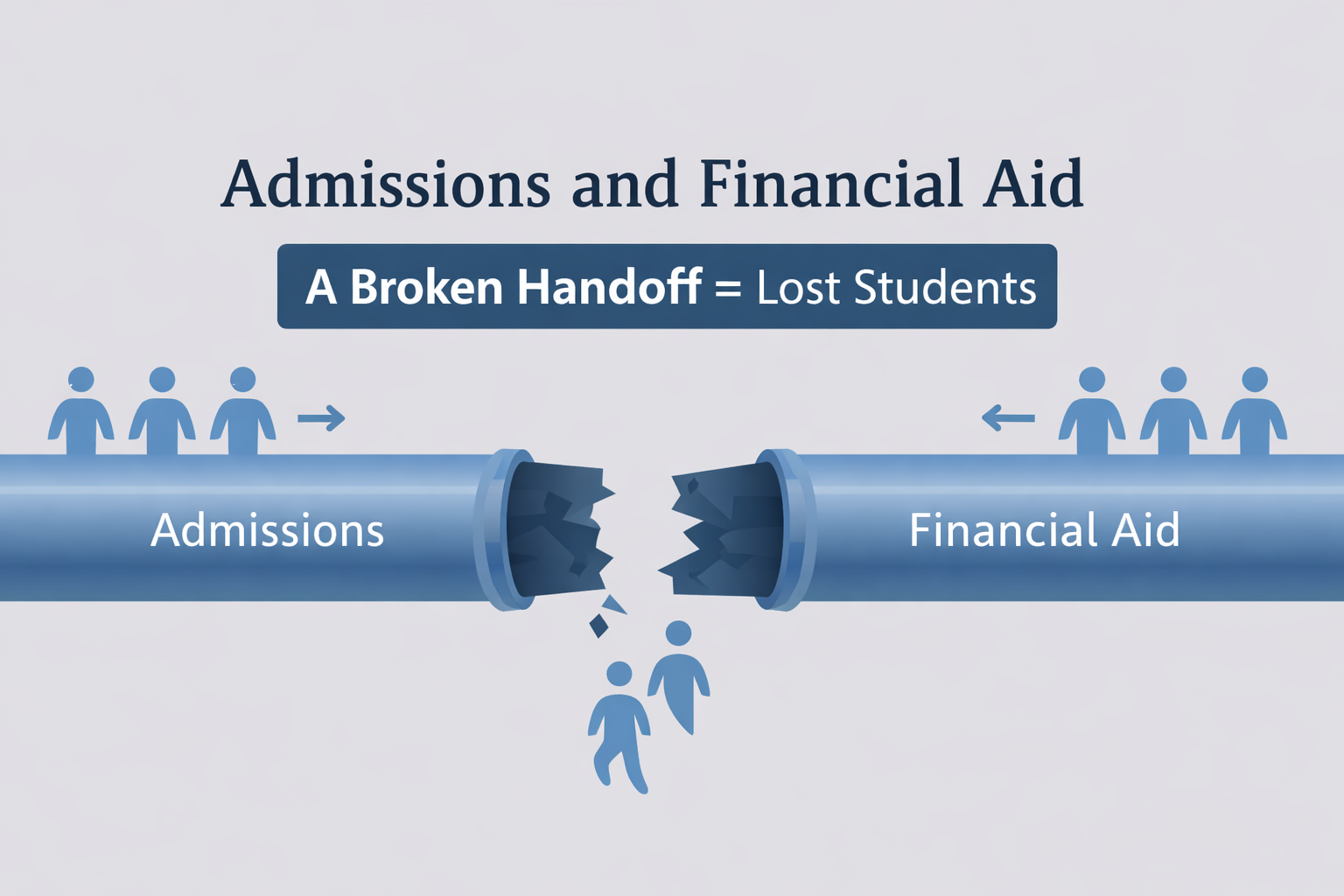
Admissions & Financial Aid Misalignment: The Hidden Driver of Enrollment Loss
One of the biggest enrollment risks isn’t external.
It’s internal.
When admissions creates momentum and financial aid introduces friction, students don’t always push back…
They disengage.
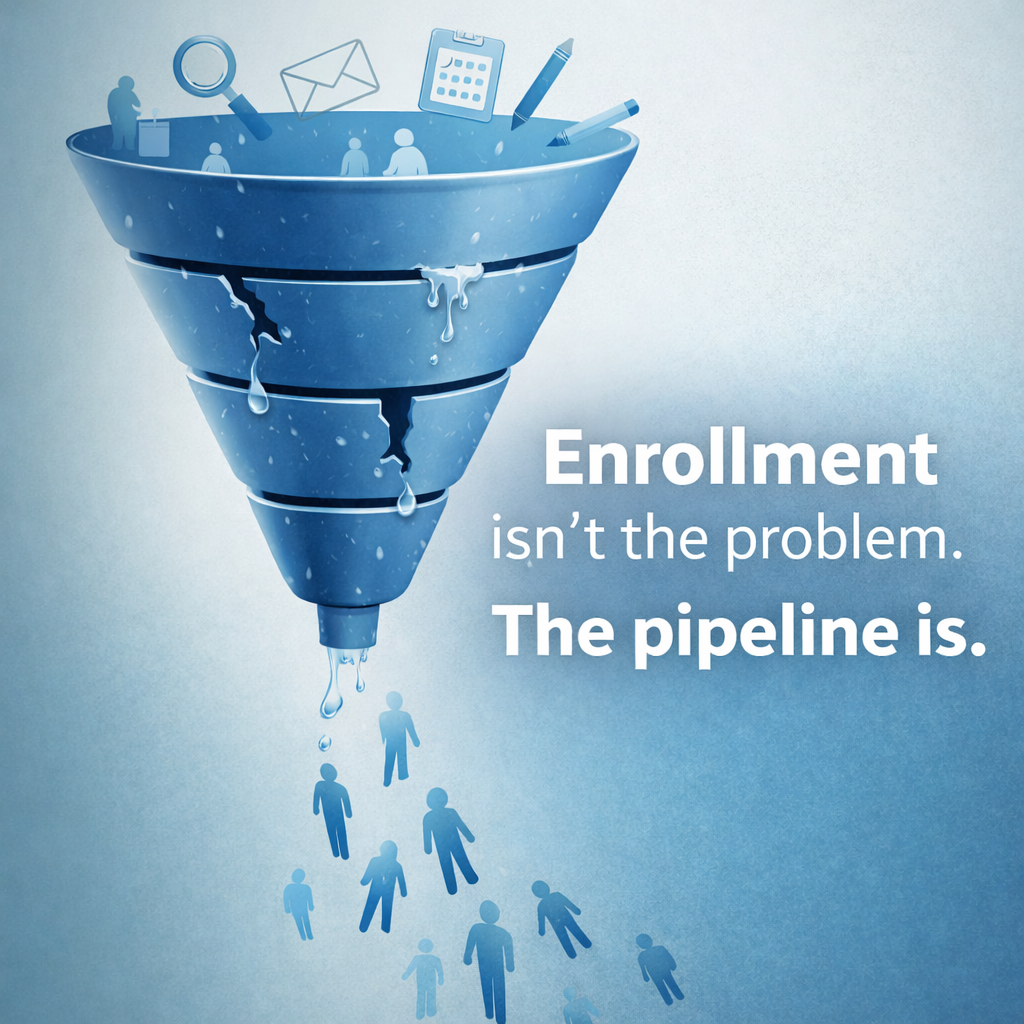
Enrollment Pipeline Leak Points: Where Institutions Are Losing Students Without Realizing It
Enrollment challenges are often treated as a demand problem.
More leads. More applications. More starts.
But what if the issue isn’t the top of the funnel…
What if students are already in your pipeline—and quietly leaking out before they ever begin?

There’s a quiet concern circulating in higher education right now—especially within proprietary institutions.
You could always tell at conferences who came from proprietary institutions…
Some were there to learn.
Others were there—and still working.
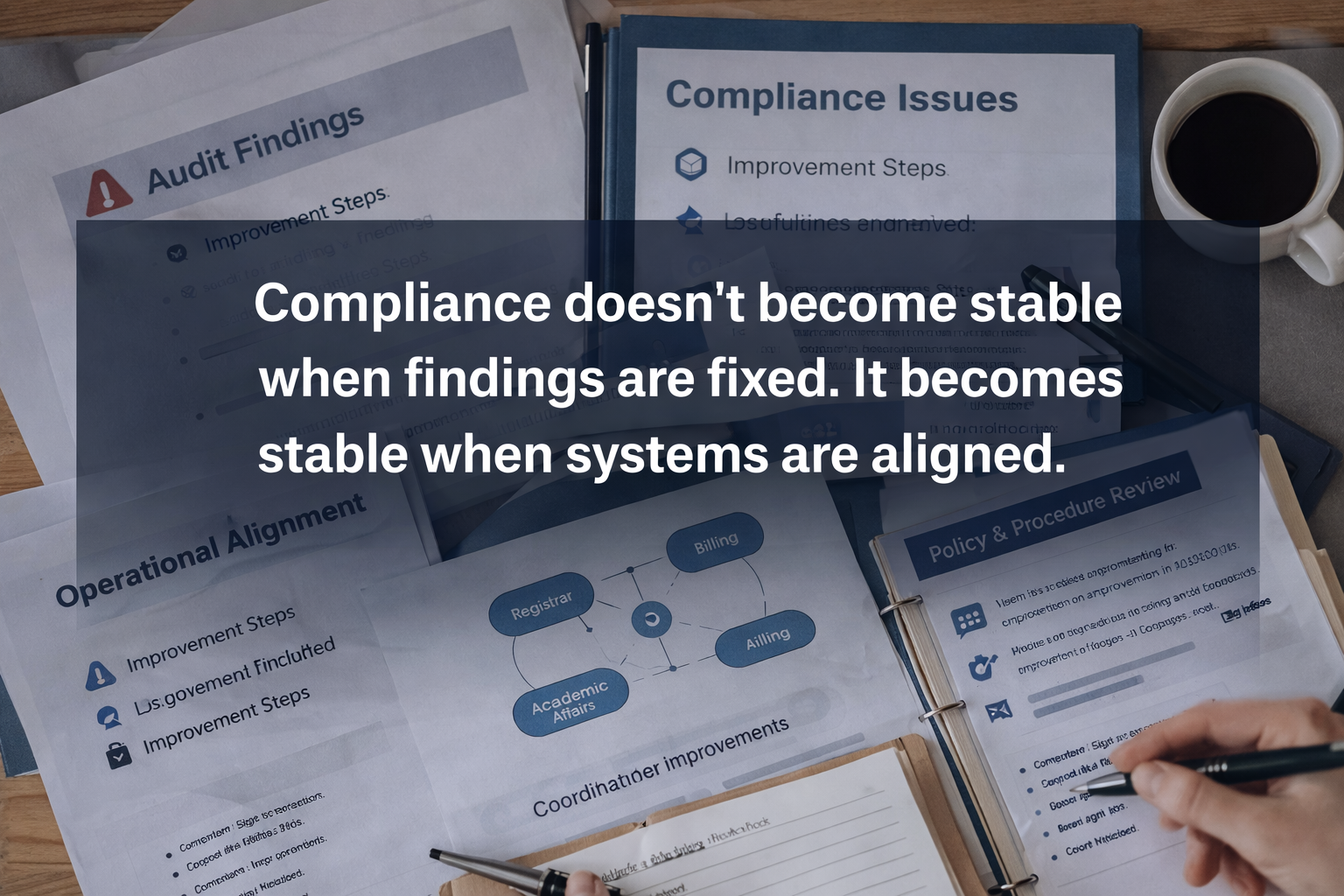
Weekend Insight: Moving from Reactive Compliance to Institutional Alignment
Long-term compliance stability is not achieved through technical fixes alone—it is built through alignment across departments, processes, and decision-making.
Weekend Insight: The Early Warning Signs of Reactive Compliance
Reactive compliance doesn’t start with major failures—it starts with small shifts in decision-making. The early warning signs are often subtle, but they reveal where risk is already taking hold.
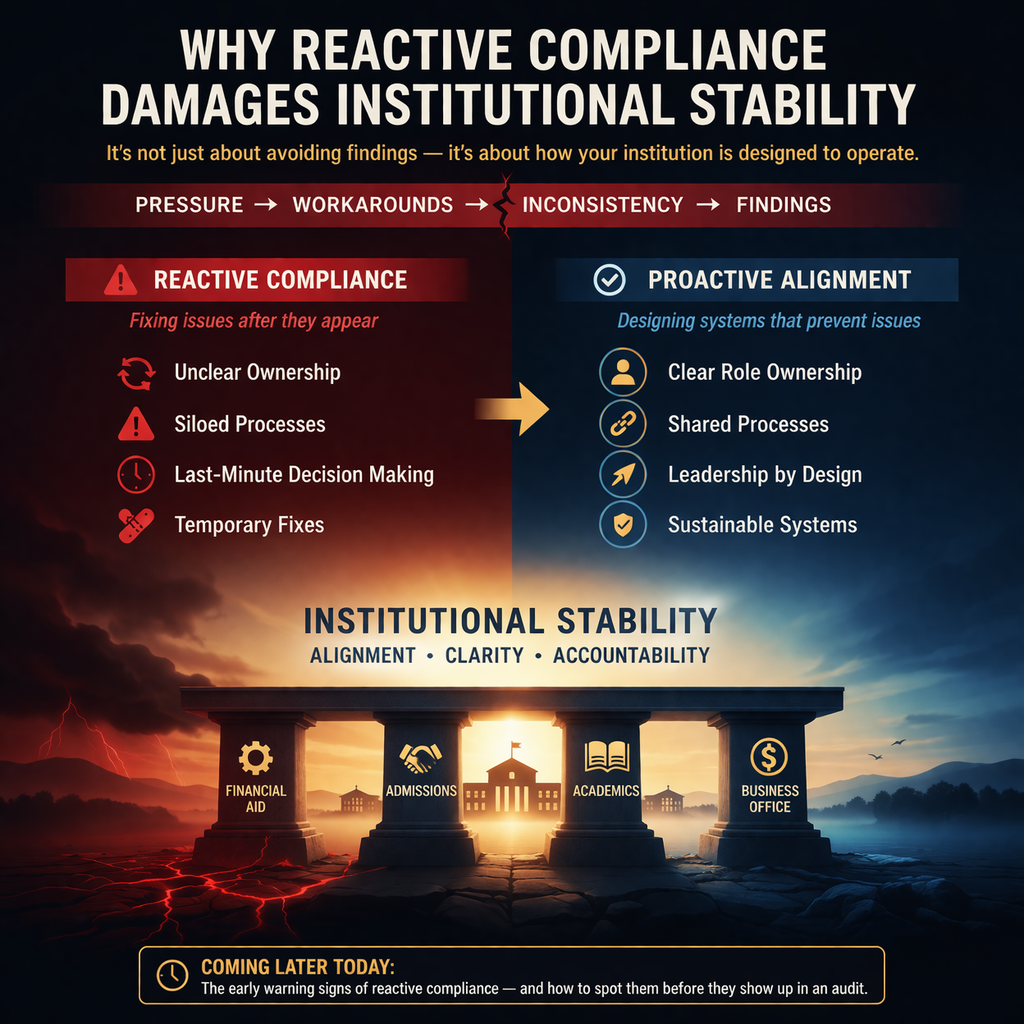
Weekend Insight: Why Reactive Compliance Damages Institutional Stability Part 1 of 3
Reactive compliance doesn’t fail because of knowledge gaps—it fails because of misalignment. Over time, small decisions become normalized behaviors, and by the time findings appear, the risk is already embedded in how the institution operates.
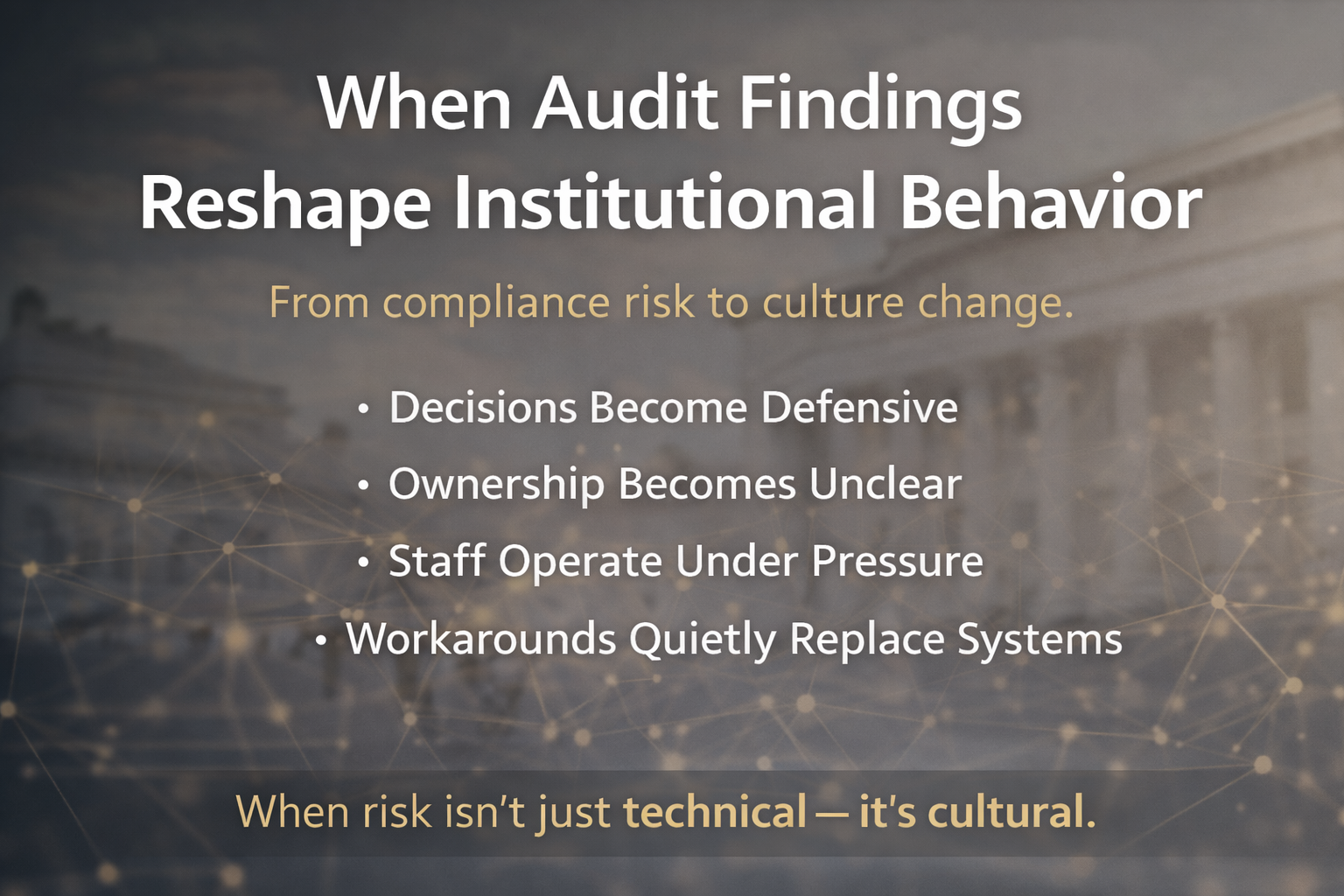
Weekend Insight: When Audit Findings Reshape Institutional Behavior (Part 2 of 3)Regulatory Risk & Accountability Systems
Audit findings don’t just identify issues—they reshape behavior. Over time, unresolved patterns shift organizations from clarity and accountability to pressure, workarounds, and normalized risk.
Weekend Insight: Audit Findings That Escalate Federal Scrutiny (Part 1 of 3)Regulatory Risk & Accountability Systems
Most audit findings do not begin as institutional risks.
They begin as small, explainable issues—documentation gaps, timing inconsistencies, or isolated process breakdowns. On their own, they rarely raise concern. But when they repeat, when they surface across functions, or when they persist over time, they begin to tell a different story.
What I have seen is that federal scrutiny is rarely triggered by a single issue—it is triggered by patterns.
By the time those patterns are visible externally, they have often been building internally through disconnected processes, unclear accountability, or systems that were never designed to operate under sustained pressure.
Audit findings, in this context, are not simply compliance events.
They are early signals of how well an institution understands—and controls—its own operations.
Blog Series: Regulatory Risk & Accountability Systems Part 3 of 3 — Alignment Is the System: What High-Functioning Institutions Are Doing Right
Alignment is often discussed as a leadership goal—but in high-functioning institutions, it operates as a system.
It is not dependent on individual effort or awareness. It is built into how decisions are made, how information flows, and how accountability is reinforced across the organization.
What I have seen in institutions that manage risk effectively is not the absence of issues—but the presence of structure. Financial aid, compliance, academic leadership, and operations are not working in parallel; they are operating from a shared understanding of risk, timing, and responsibility.
In these environments, small issues do not escalate—not because they are avoided, but because they are identified, communicated, and resolved within a system designed to withstand pressure.
Alignment, in this sense, is not cultural language.
It is operational design.
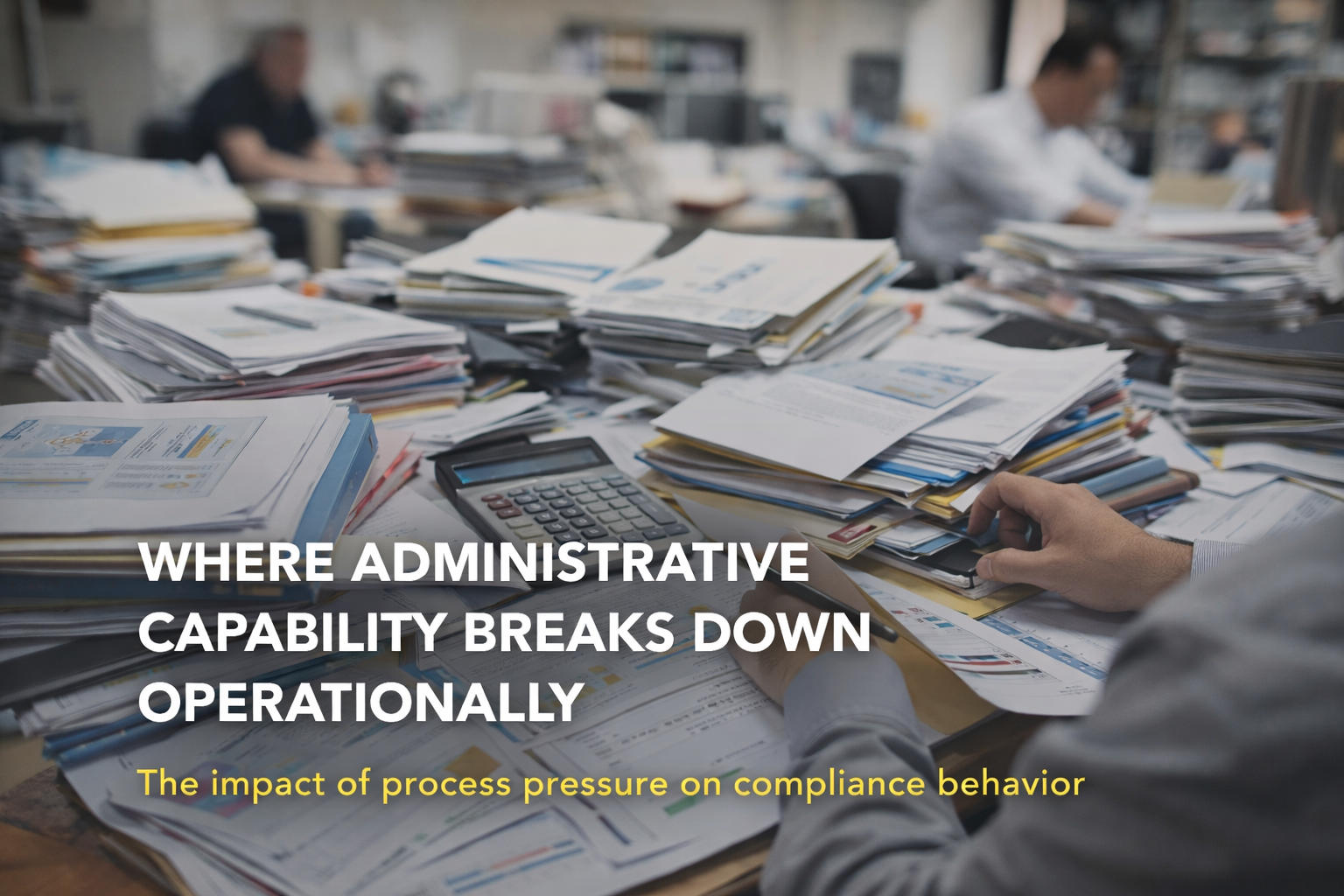
Blog Series: Regulatory Risk & Accountability Systems Part 2 of 3 — Where Administrative Capability Breaks Down Operationally
Administrative capability doesn’t break down in policy—it breaks down in practice.
Under pressure, small operational decisions begin to shift: timelines compress, processes adjust, and consistency gives way to momentum.
Individually manageable.
Collectively risky.
This is where compliance begins to erode.
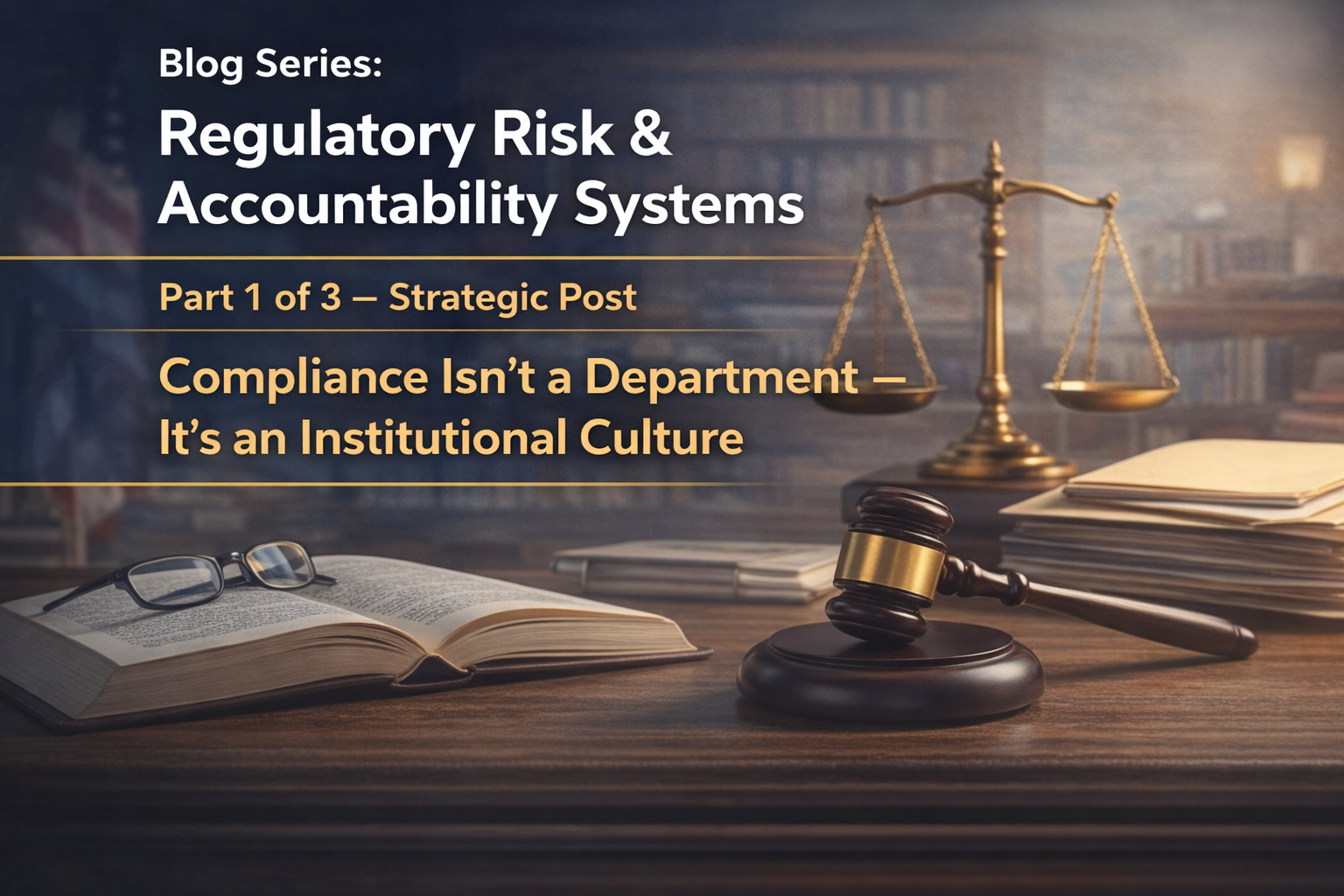
Blog Series: Regulatory Risk & Accountability Systems Part 1 of 3 — Strategic Post: Compliance Isn’t a Department — It’s an Institutional Culture
Compliance doesn’t fail because people don’t understand the rules.
It fails when institutions treat it as a function—rather than a culture embedded in how decisions are made across Admissions, Financial Aid, and leadership.
This is where risk begins.
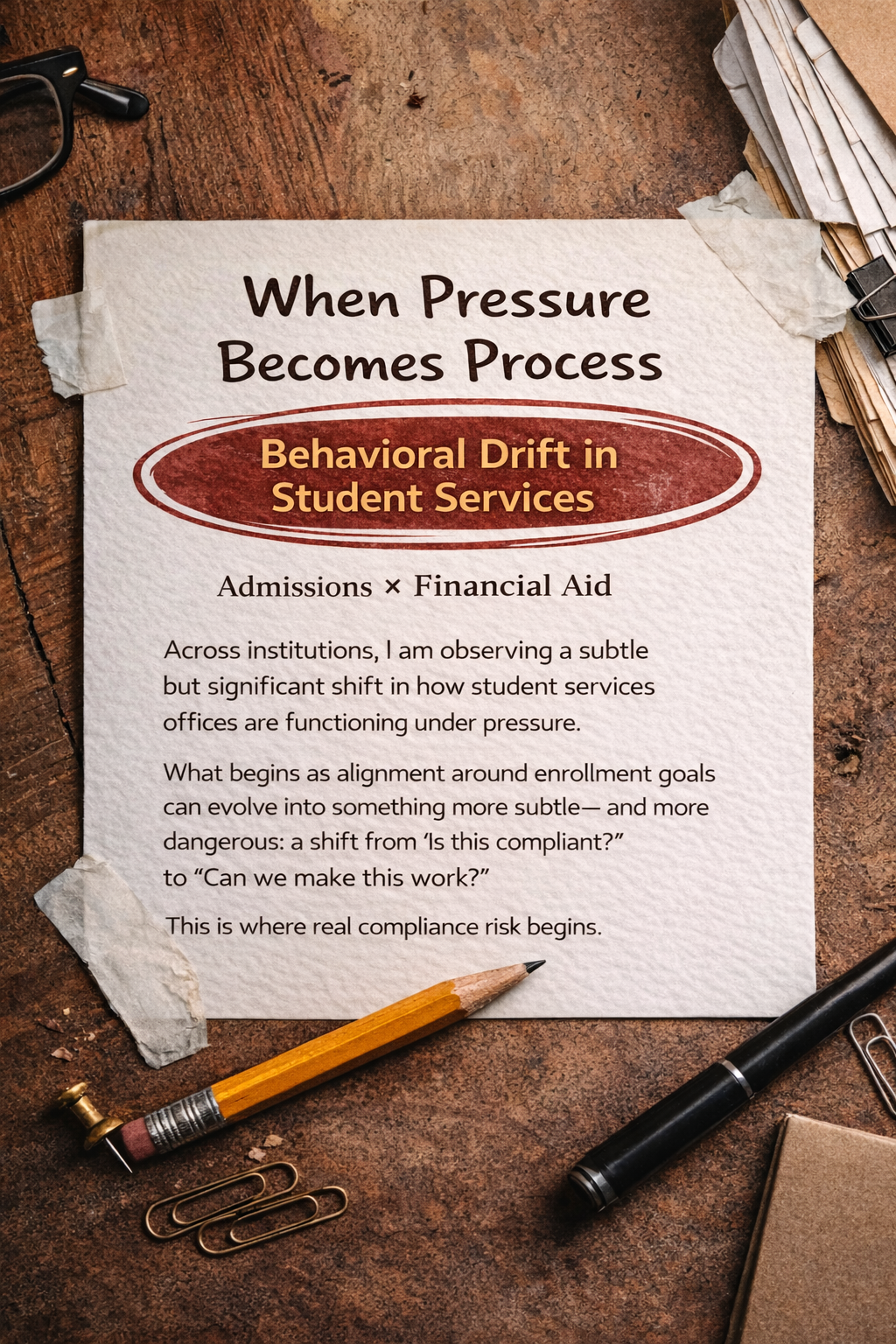
When Pressure Becomes Process: What I Am Seeing Inside Student Services Right Now
Pressure inside student services is quietly reshaping behavior across Admissions and Financial Aid—not through policy changes, but through daily operational decisions.
What begins as alignment around enrollment goals can evolve into something more subtle—and more dangerous: a shift from “Is this compliant?” to “Can we make this work?”
This is where real compliance risk begins.
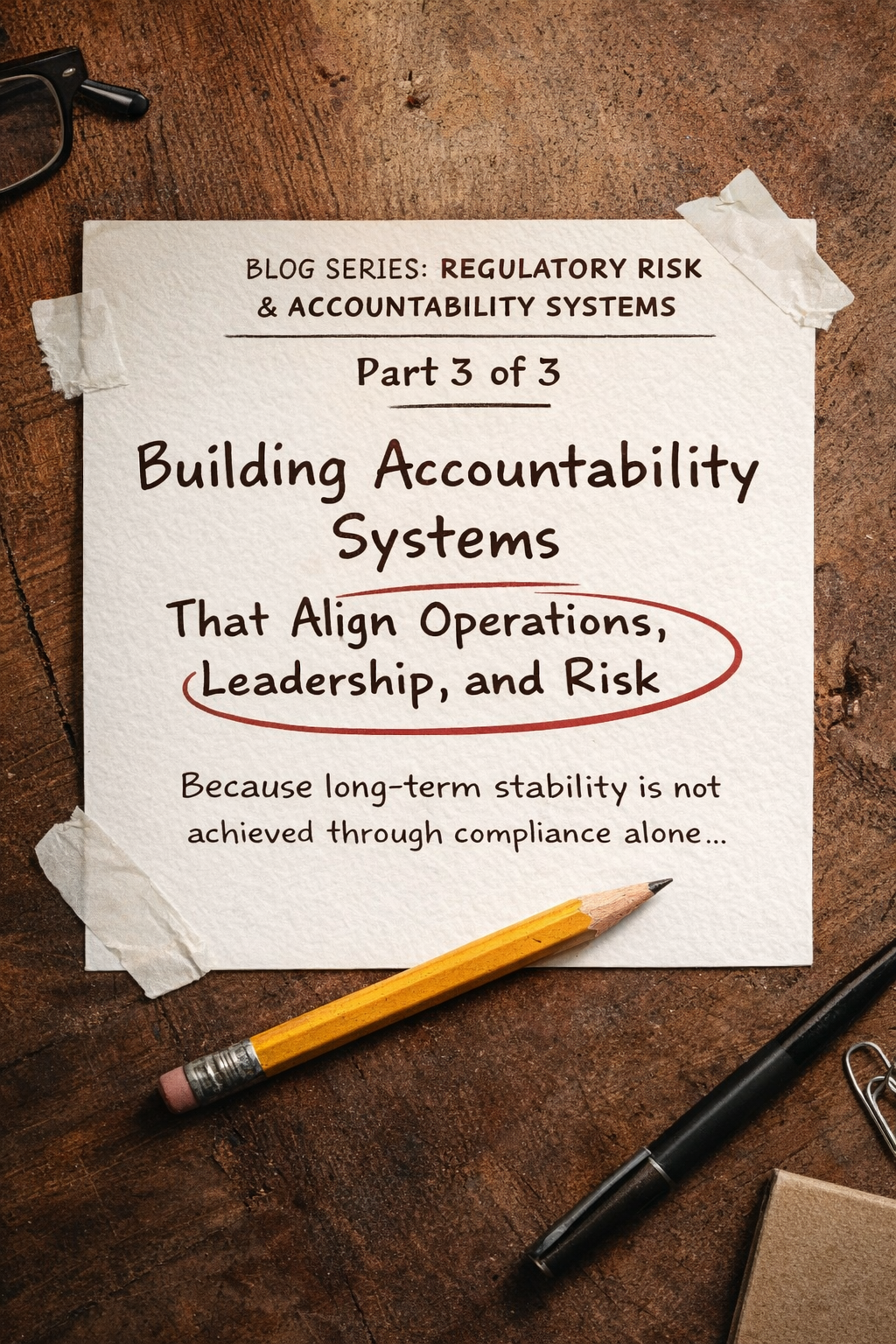
Blog Series: Regulatory Risk & Accountability Systems Part 3 of 3 — Building Accountability Systems That Align Operations, Leadership, and Risk
What I am seeing from institutions that are getting this right is not perfection—it’s alignment. This post examines how leading institutions connect operations, leadership, and risk to move from reactive compliance to proactive, sustainable stability.
Blog Series: Regulatory Risk & Accountability Systems Part 2 of 3 — Where Administrative Capability Breaks Down Operationally
What I am seeing across institutions is not a lack of regulatory knowledge—it’s a breakdown in execution. Administrative capability is not lost in policy manuals; it erodes in the day-to-day intersections between financial aid, admissions, academics, and leadership. And that’s where risk begins to build.

Blog Series: Regulatory Risk & Accountability Systems Part 1 of 3 — Administrative Capability as a Leading Indicator of Federal Confidence
Administrative capability is more than a compliance requirement—it is a leading indicator of federal confidence and institutional risk. Based on active work with colleges and universities, this analysis examines how operational execution—not policy—drives audit outcomes and long-term stability.