

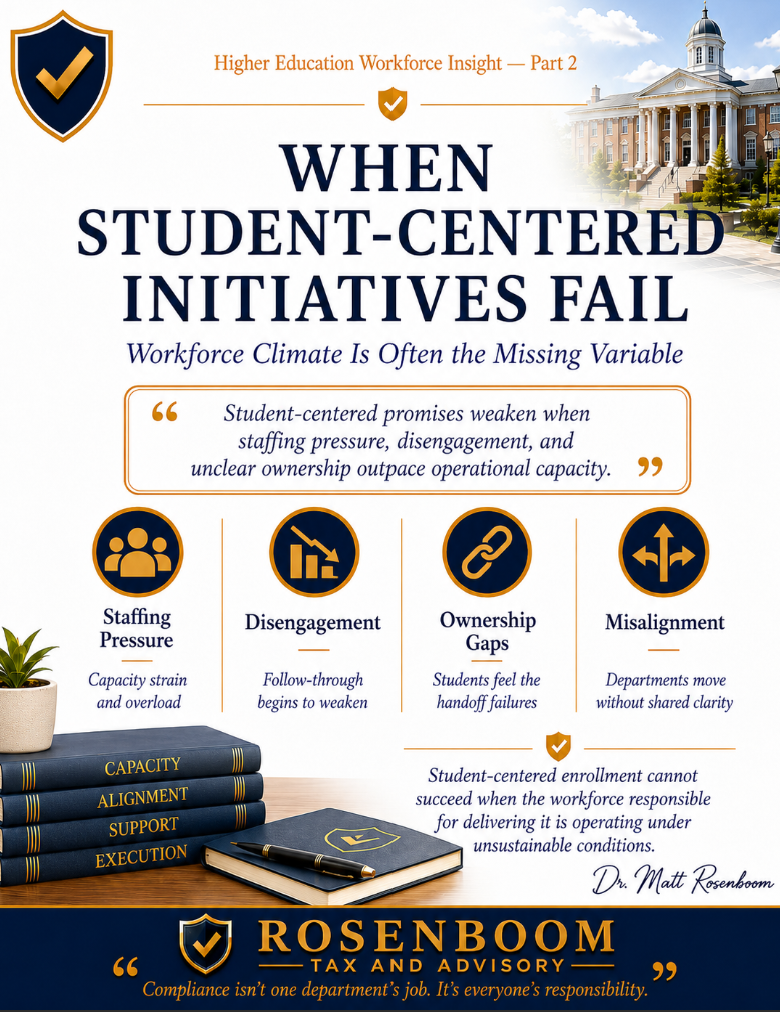
When Student-Centered Initiatives Fail, Workforce Climate Is Often the Missing Variable The Student Experience Cannot Outperform the Staff Experience
Student-centered initiatives often fail when institutions do not measure the workforce climate responsible for delivering them. Staffing pressure, disengagement, unclear ownership, communication breakdowns, and cross-functional misalignment can weaken even the strongest student experience strategies. This post explains why student-centered enrollment requires operational capacity, workforce support, and institutional alignment behind the promise.
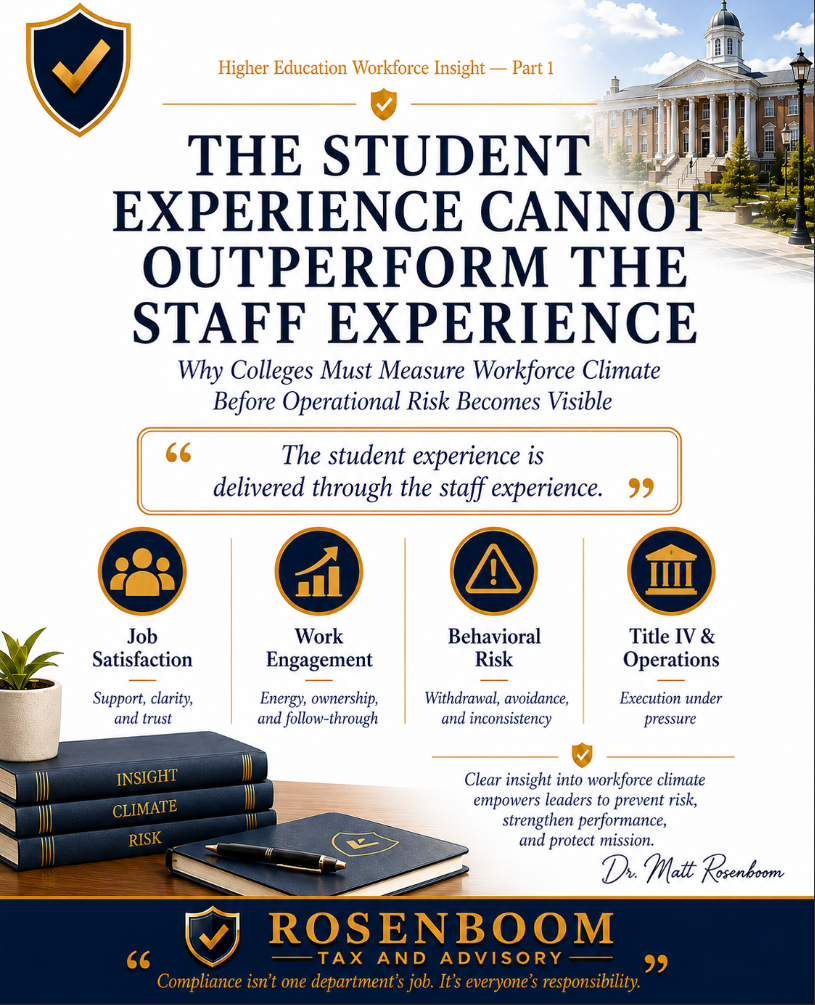
The Student Experience Cannot Outperform the Staff Experience: Why Colleges Must Measure Workforce Climate Before Operational Risk Becomes Visible
The student experience is delivered through the staff and faculty experience. This post explains why colleges cannot sustainably improve student-centered enrollment, communication, compliance, or service outcomes without measuring workforce climate. Job satisfaction, work engagement, and behavioral risk are not just HR concerns — they are institutional performance indicators that shape student experience, Title IV execution, operational stability, and long-term risk.
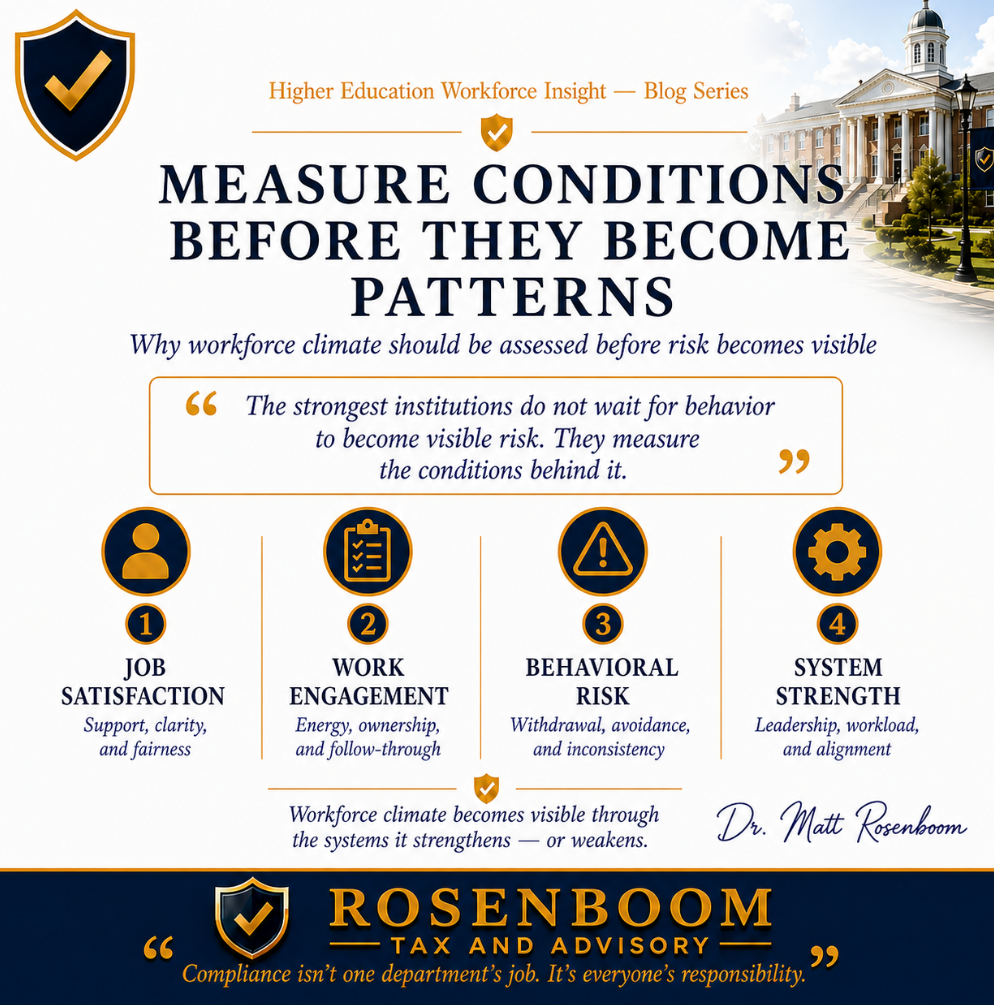
Why Colleges Should Measure Counterproductive Work Behavior Before It Becomes Visible Job Satisfaction, Work Engagement, and Counterproductive Work Behavior in College Staff and Faculty
Counterproductive work behavior does not always begin as obvious misconduct. In colleges, it can appear quietly through withdrawal, avoidance, poor communication, delayed follow-up, reduced effort, passive noncompliance, and inconsistent collaboration. This post explains why those behaviors should be viewed as organizational signals — and why measuring job satisfaction, work engagement, and behavioral risk can help institutions identify workforce climate issues before they become turnover, complaints, compliance exposure, or operational breakdowns.
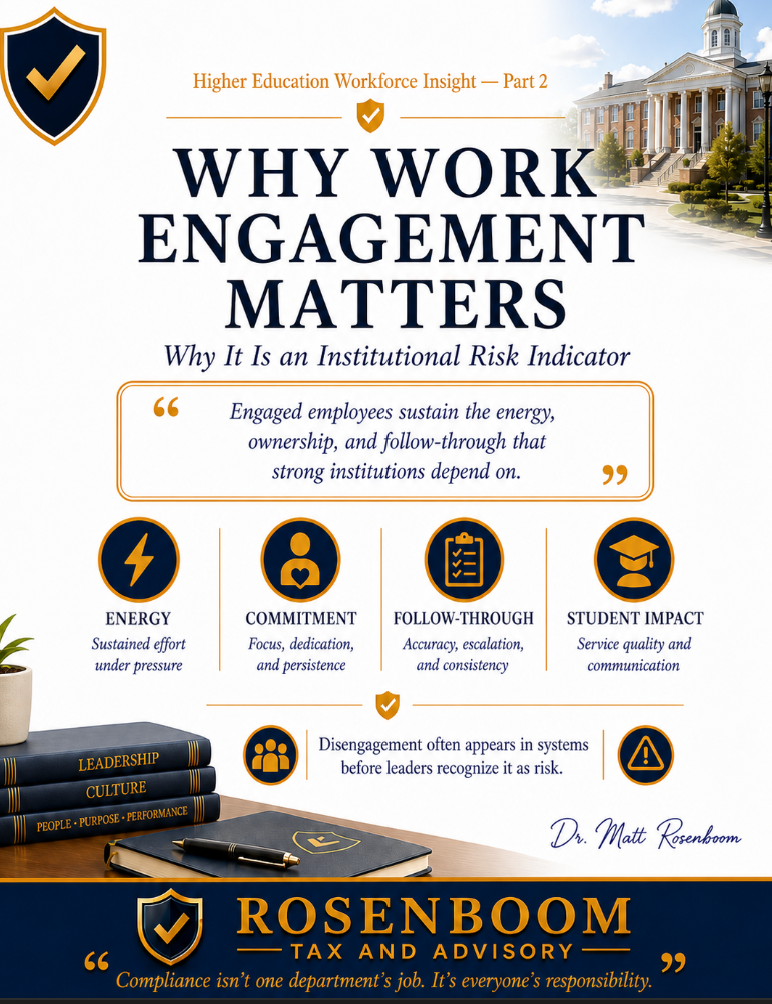
Why Work Engagement Is an Institutional Risk Indicator Job Satisfaction, Work Engagement, and Counterproductive Work Behavior in College Staff and Faculty
Work engagement is not the same as being busy. In higher education, engaged employees bring the energy, focus, ownership, and follow-through needed to sustain student service, compliance execution, documentation quality, and cross-functional communication under pressure. This post explains why disengagement can become an institutional risk indicator long before leaders see turnover, complaints, errors, or audit findings.
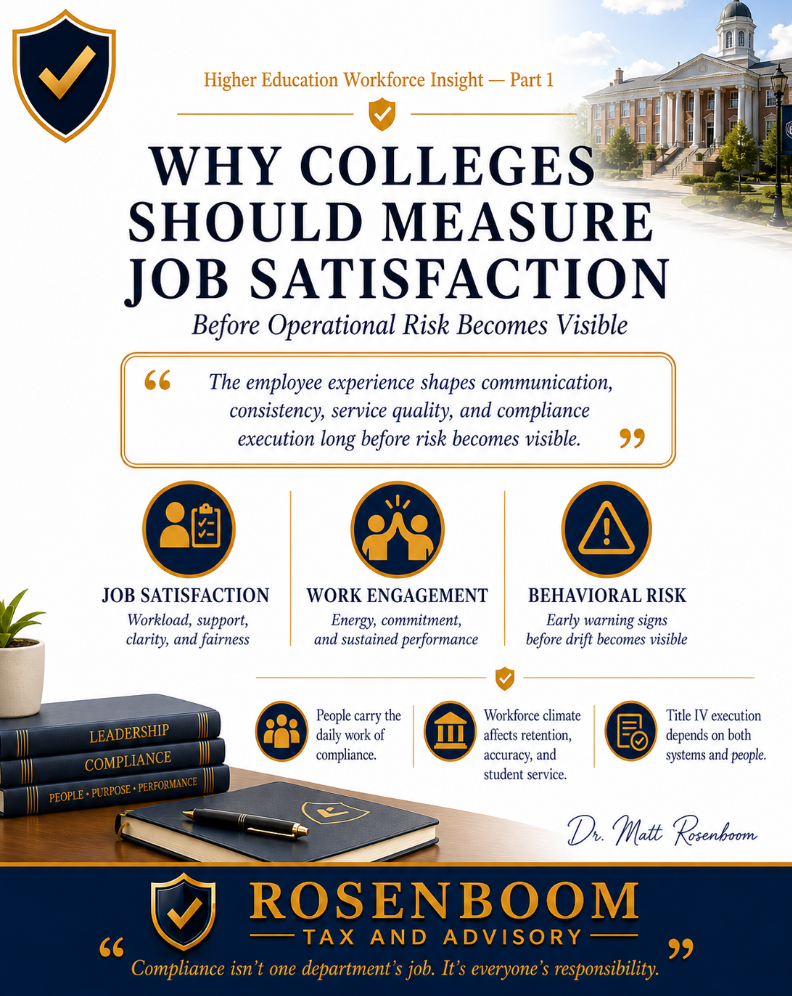
Why Colleges Should Measure Job Satisfaction Before Operational Risk Becomes VisibleJob Satisfaction, Work Engagement, and Counterproductive Work Behavior in College Staff and Faculty
Colleges measure enrollment, retention, compliance outcomes, and financial performance, but many do not meaningfully measure the employee experience driving those outcomes. This post explains why job satisfaction is more than morale — it is an institutional stability, operational risk, and Title IV compliance issue. When staff satisfaction declines, the effects can appear in communication, service quality, documentation, consistency, turnover risk, and compliance execution long before formal findings become visible.
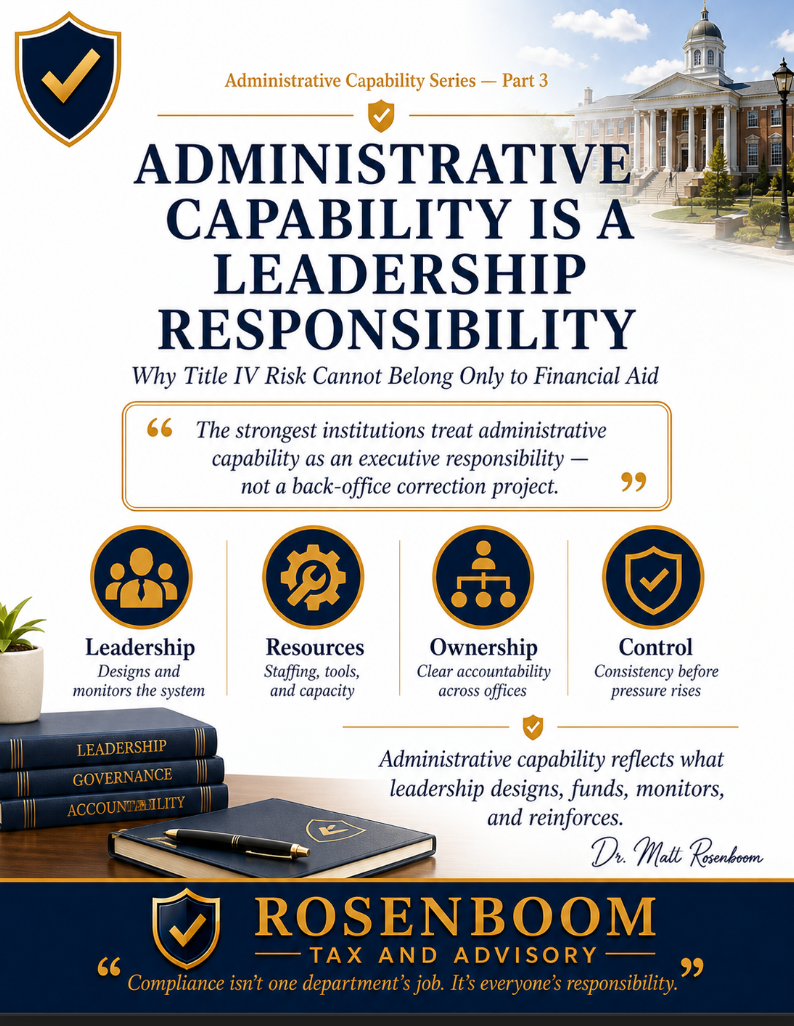
Administrative Capability Is a Leadership Responsibility Administrative Capability Is Not a File Review Issue
Administrative capability cannot belong only to Financial Aid. It reflects what leadership designs, funds, monitors, and reinforces across staffing, enrollment pressure, reconciliation, communication, ownership, and institutional governance. This post explains why Title IV risk is ultimately a leadership responsibility — and why strong institutions evaluate capability before pressure turns weakness into evidence.
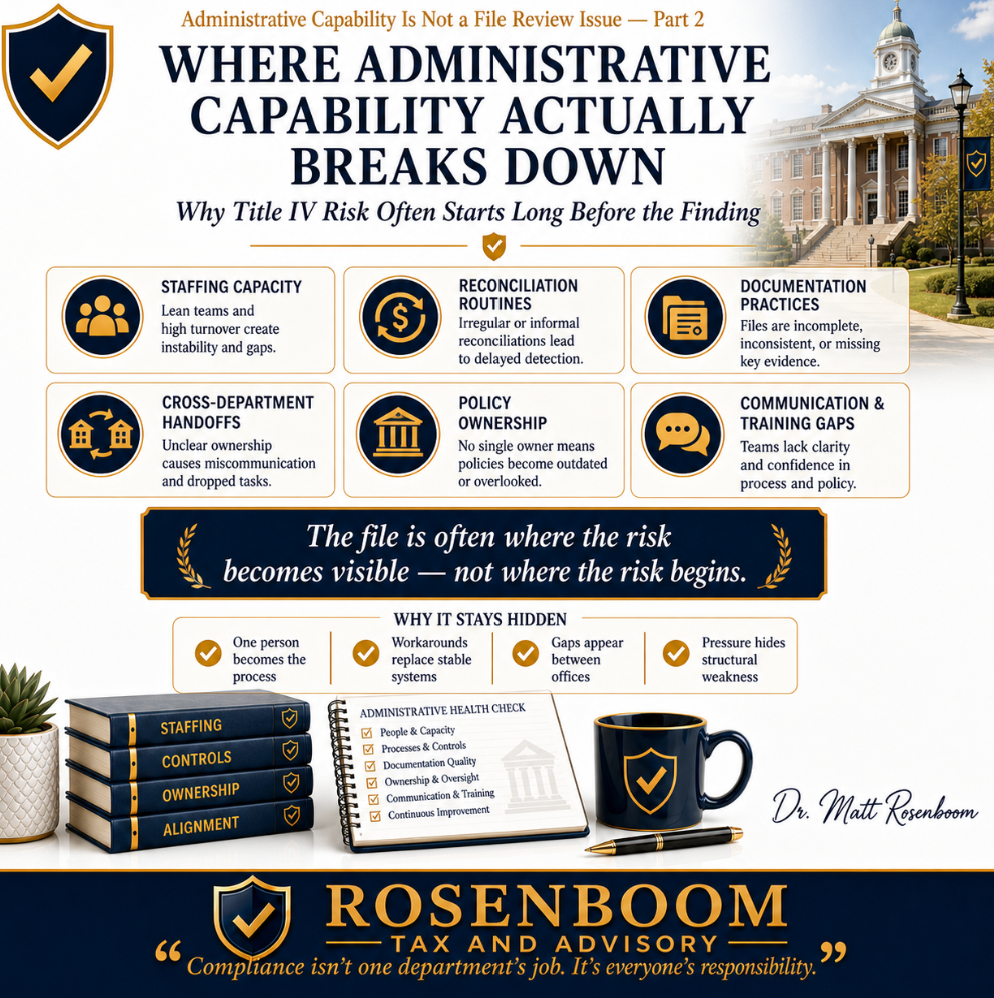
Where Administrative Capability Actually Breaks Down Administrative Capability Is Not a File Review Issue
Administrative capability rarely breaks down in the file first. It usually weakens upstream in staffing capacity, reconciliation routines, documentation practices, cross-department handoffs, policy ownership, communication, training, and leadership assumptions. This post examines the operational gaps that often remain invisible until an audit, program review, complaint, or finding exposes them.

Administrative Capability Is Not a File Review Issue Why Title IV Risk Begins Long Before the Audit Finding
Administrative capability is not just a Financial Aid file review issue. It is an institutional control system involving staffing, workflow, ownership, reconciliation, communication, and leadership structure. This post explains why Title IV risk often begins long before an audit finding appears — and why institutions should evaluate operational capability before fall pressure exposes the gaps.
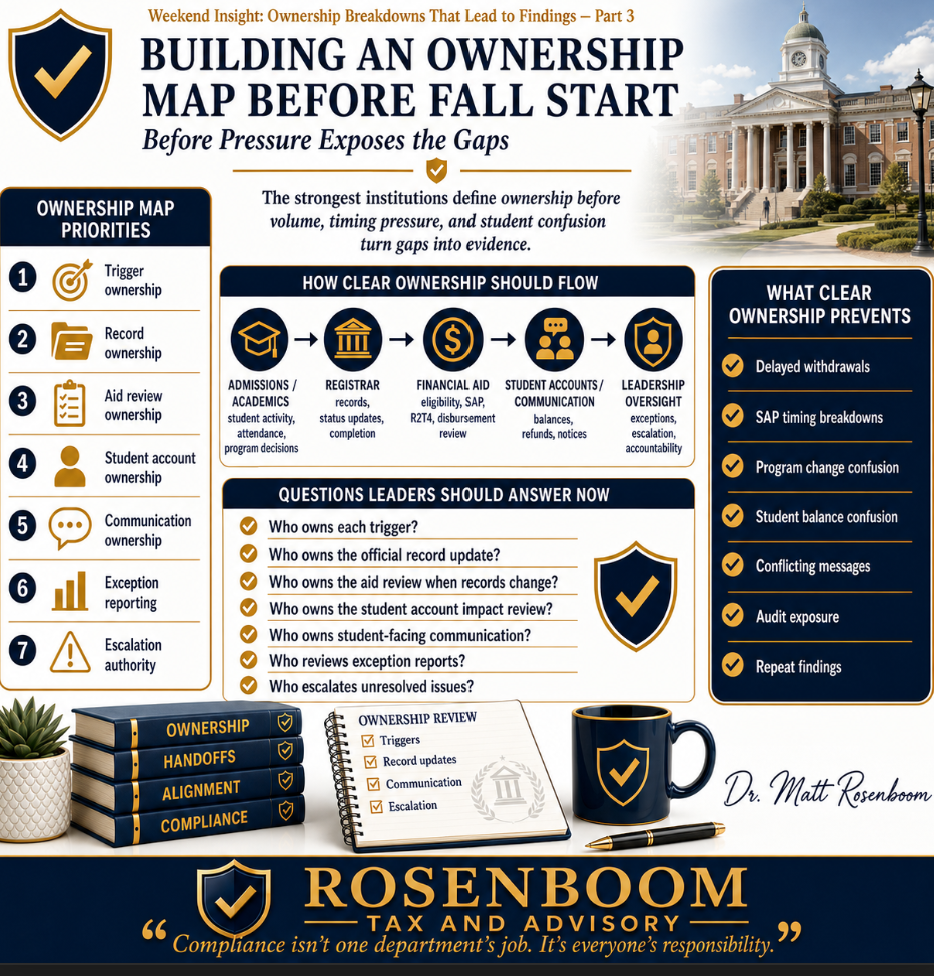
Weekend Insight: Ownership Breakdowns That Lead to Findings: Building an Ownership Map Before Fall Start Pressure Exposes the Gaps
Ownership mapping helps institutions clarify responsibility before fall start pressure turns process gaps into findings. This final Weekend Insight explains why leaders should define trigger ownership, record ownership, aid review ownership, student account ownership, communication ownership, exception reporting, escalation authority, and leadership oversight before volume, timing pressure, and student confusion expose the gaps.
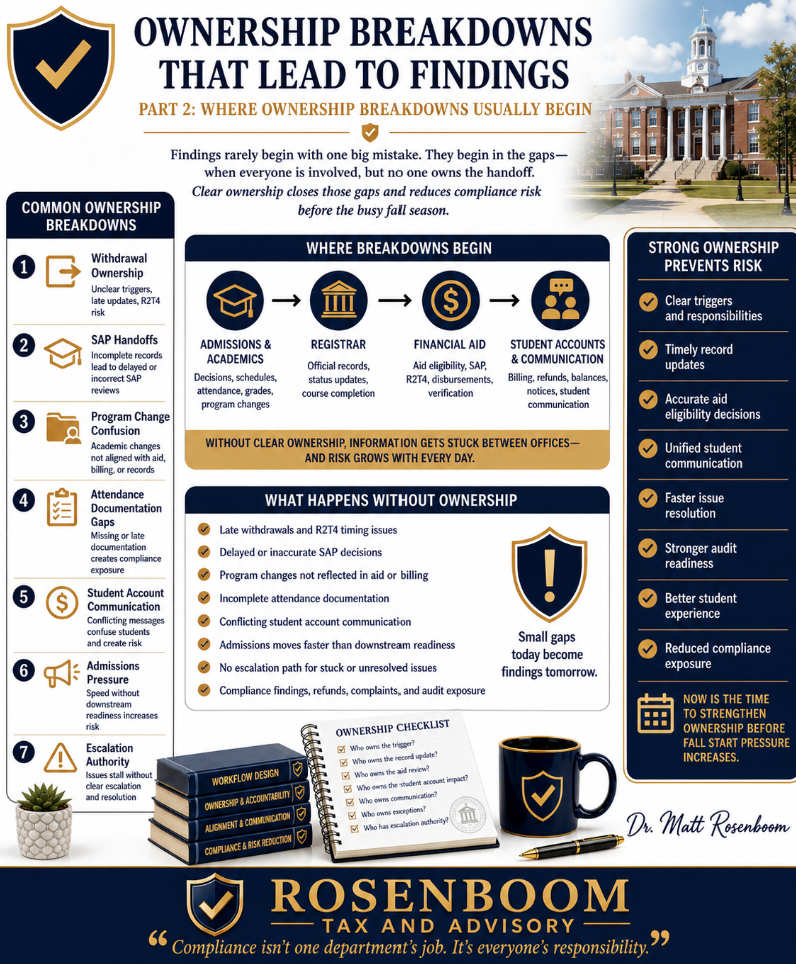
Weekend Insight: Ownership Breakdowns That Lead to Findings: Where Ownership Breakdowns Usually Begin
Ownership breakdowns often begin in the handoffs between Admissions, Academics, the Registrar, Financial Aid, and Student Accounts. This second Weekend Insight examines the specific places where ownership gaps usually develop, including withdrawals, SAP handoffs, program changes, attendance documentation, student account communication, admissions pressure, and missing escalation authority before the busy fall start season.
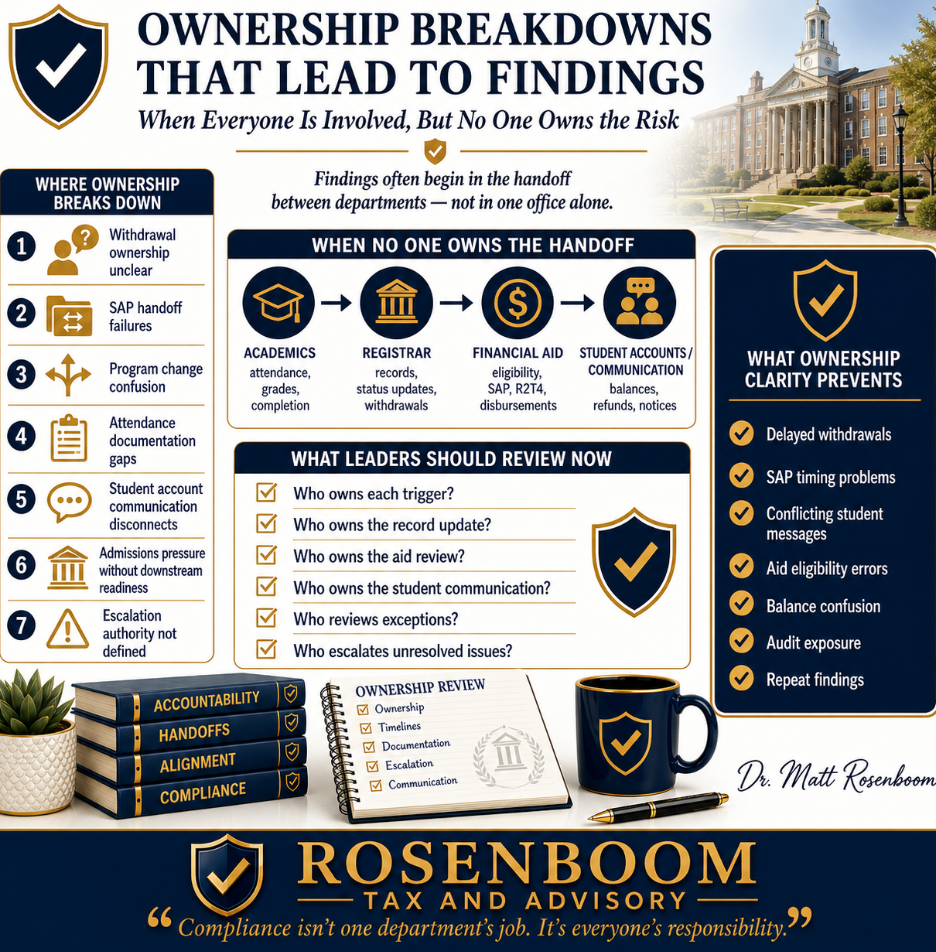
Weekend Insight: Ownership Breakdowns That Lead to Findings: When Everyone Is Involved, But No One Owns the Risk
Ownership breakdowns are one of the most common reasons compliance findings develop. When everyone is involved but no one owns the trigger, record update, aid review, student communication, exception report, or escalation process, small delays can become institutional risk. This Weekend Insight examines why now is the right time to clarify ownership before fall start pressure exposes the gaps.
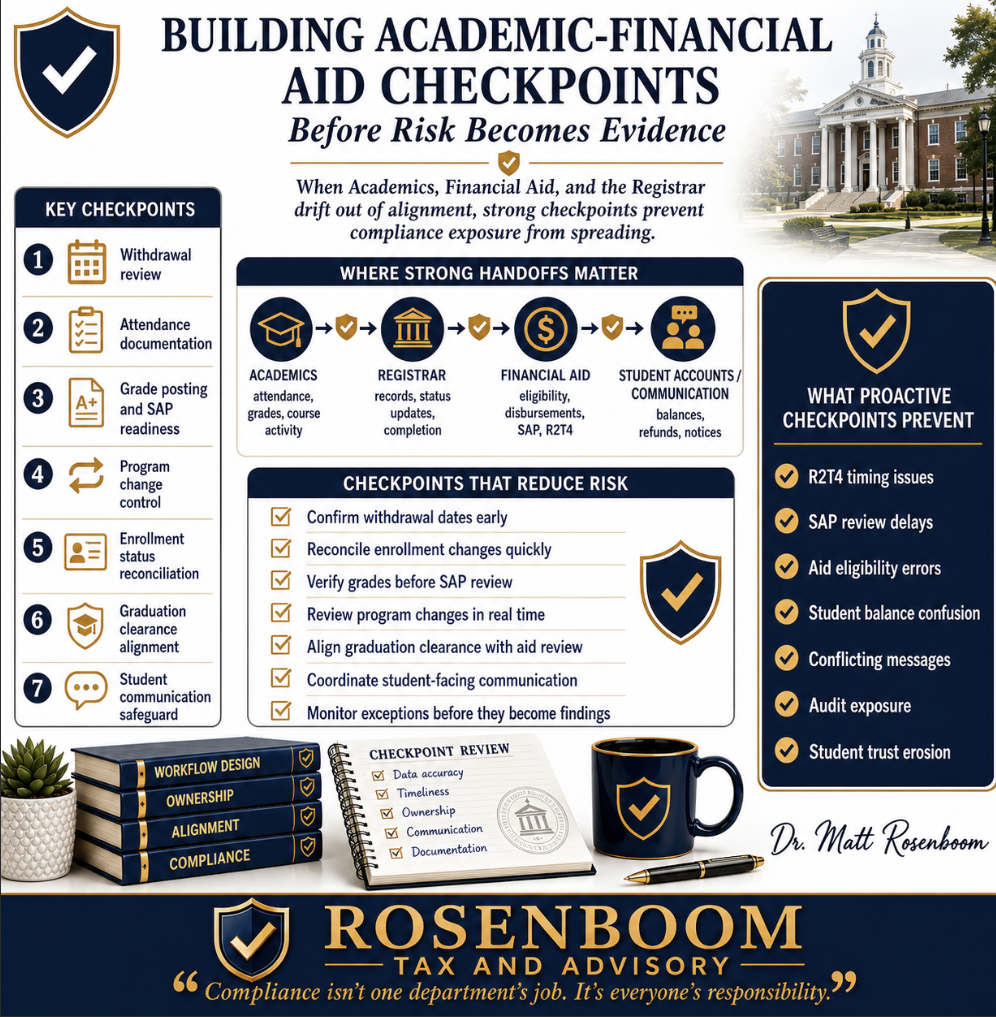
When Academics, Financial Aid, and the Registrar Drift Out of Alignment: Building Academic-Financial Aid Checkpoints Before Risk Becomes Evidence
Academic-financial aid checkpoints help institutions identify compliance risk before it becomes evidence in a file review, audit, program review, or student complaint. This final installment examines the controls institutions should build around withdrawals, attendance documentation, grade posting, SAP readiness, program changes, enrollment status, graduation clearance, student communication, exception reporting, ownership, and leadership review.
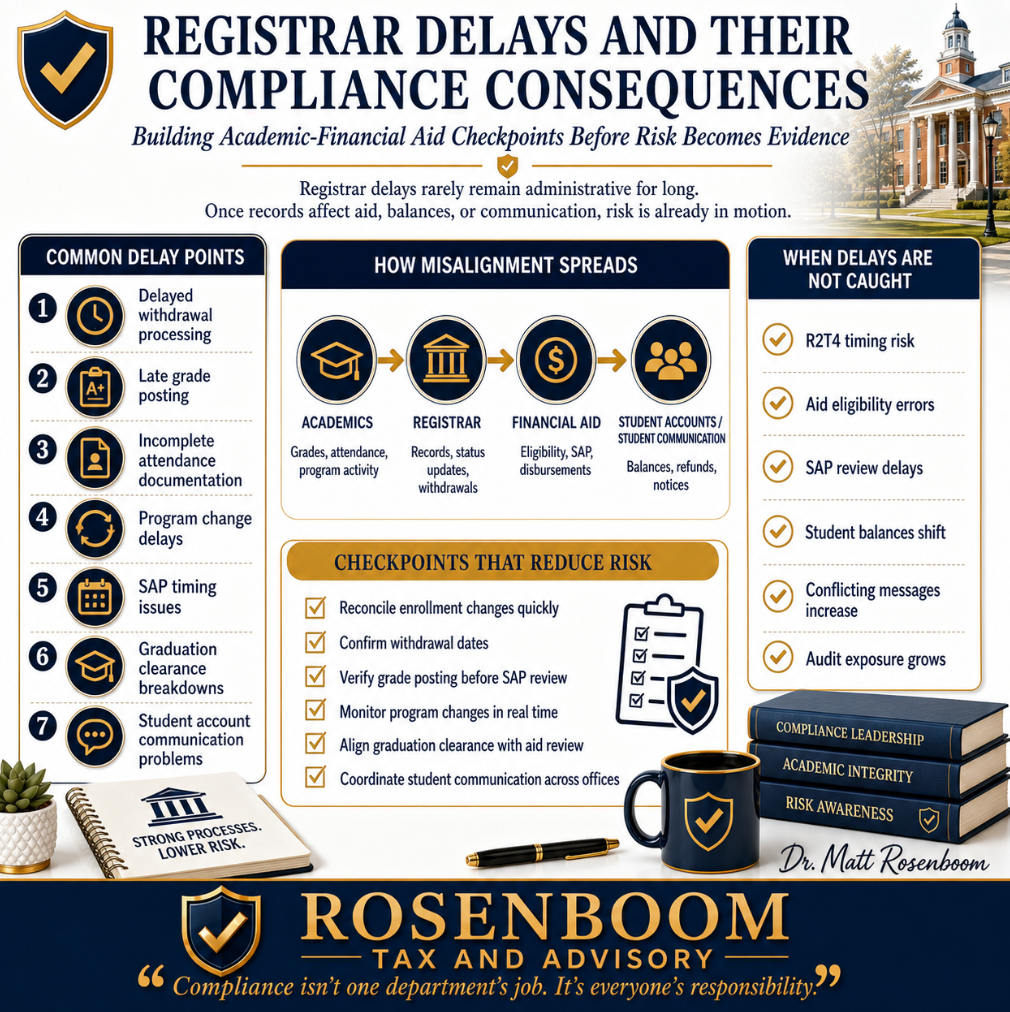
When Academics, Financial Aid, and the Registrar Drift Out of Alignment: Registrar Delays and Their Compliance Consequences Registrar Delays Rarely Stay Administrative for Long
Registrar delays rarely stay administrative for long. When withdrawal processing, grade posting, attendance documentation, program changes, SAP timing, graduation clearance, or student account communication fall behind, the delay can quickly become Title IV risk. This post examines where Registrar-related timing gaps create downstream compliance exposure — and why institutions need academic-financial aid checkpoints before risk becomes evidence.
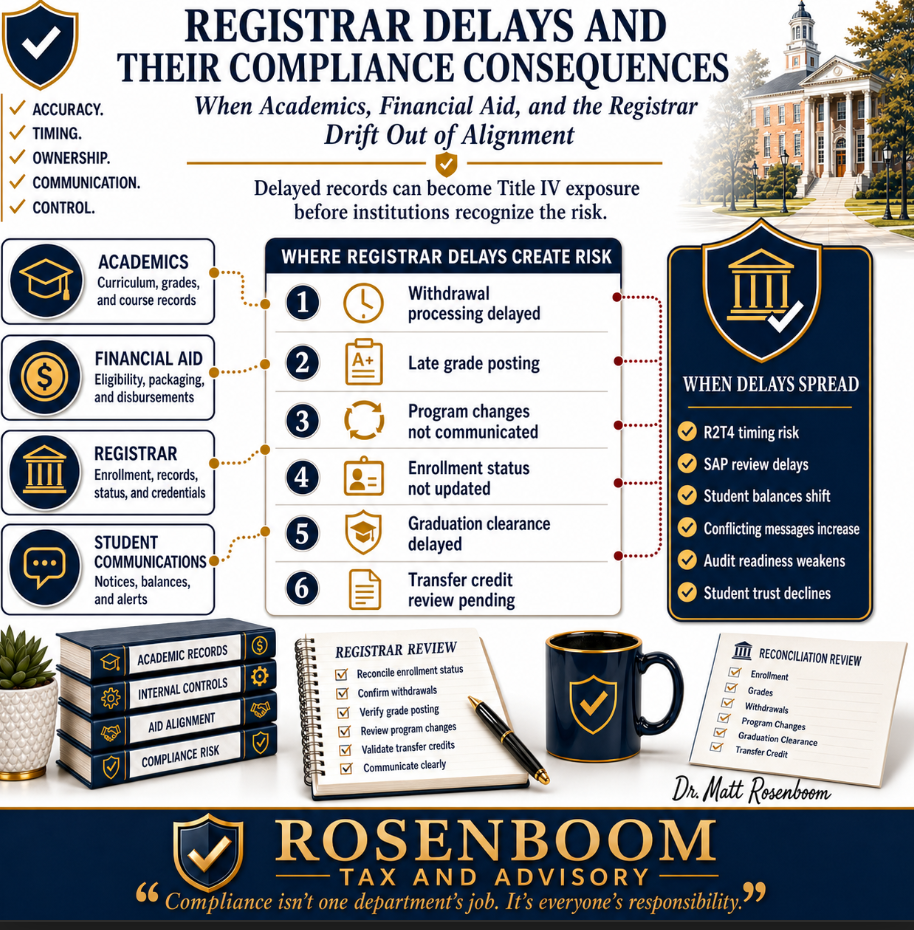
When Academics, Financial Aid, and the Registrar Drift Out of Alignment Registrar Delays and Their Compliance Consequences Building Academic-Financial Aid Checkpoints Before Risk Becomes Evidence
Registrar delays are not just administrative delays. In a Title IV environment, late withdrawal processing, delayed grade posting, unresolved program changes, pending graduation clearance, and incomplete academic records can quickly become Financial Aid risk, student account confusion, audit exposure, and institutional compliance evidence. This post examines why leadership must build stronger checkpoints between Academics, Registrar, Financial Aid, Business Office, and student communications before routine delays become institutional risk.

When Academics and Financial Aid Drift Out of Alignment Why Academic Decisions Become Financial Aid Risk Before Anyone Calls It Compliance Risk — Where the Drift Begins
Part 2 examines where Academics and Financial Aid most often drift out of alignment: attendance, withdrawals, grades, repeated coursework, SAP, program changes, and graduation clearance. When academic records move through the institution without shared timing, meaning, and ownership, compliance risk begins long before anyone calls it a finding.
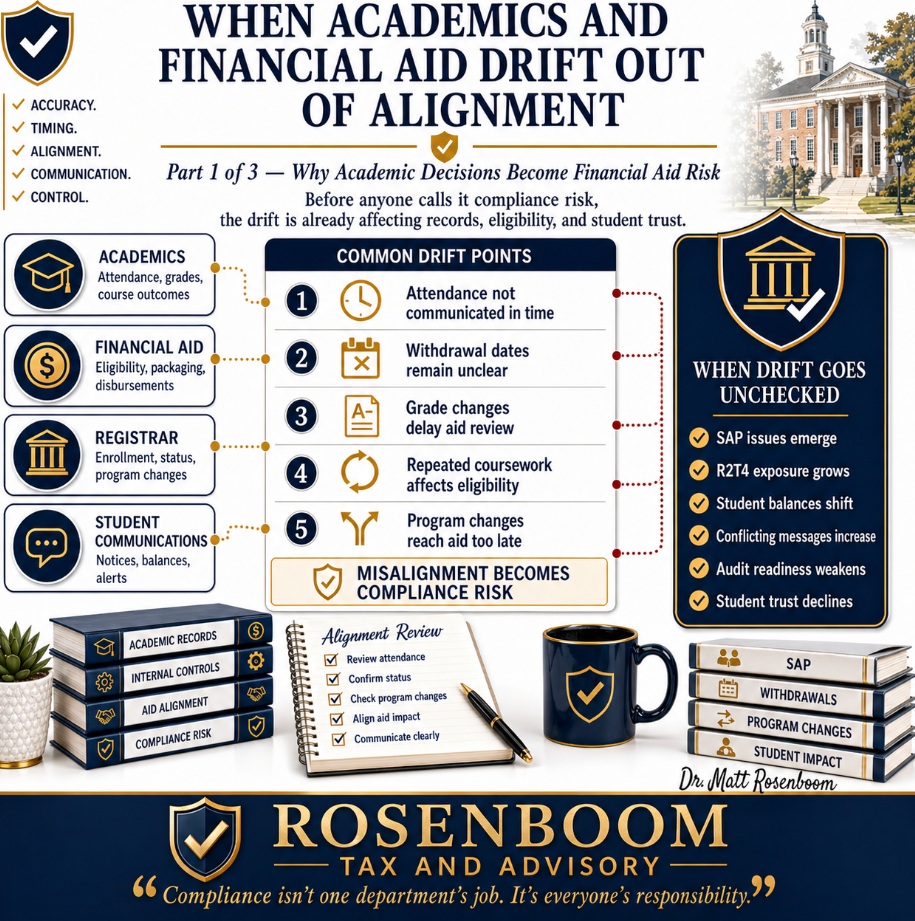
When Academics and Financial Aid Drift Out of Alignment — Why Academic Decisions Become Financial Aid Risk Before Anyone Calls It Compliance Risk
When Academics and Financial Aid drift out of alignment, the issue rarely begins as a finding. It begins in the small gaps between attendance, grades, withdrawals, program changes, and aid eligibility — long before anyone formally calls it compliance risk. In Part 1, Dr. Matt Rosenboom examines why academic decisions become Financial Aid risk, how institutional drift creates exposure across records and student communication, and why his consulting approach goes beyond policy review to examine the human and operational systems beneath the breakdown.

When the Business Office Becomes a Compliance Signal Why Student Account Ownership Cannot Be Ambiguous: Building Reconciliation Checkpoints Before Student Account Issues Become Institutional Evidence
Student account issues should not become visible for the first time through a student complaint, balance dispute, refund question, or audit inquiry. In Part 3, Dr. Matt Rosenboom explains why leadership teams must build practical reconciliation checkpoints between the Business Office, Financial Aid, Registrar, Academics, and student communication workflows before account discrepancies become institutional evidence of weak controls. Strong institutions do not wait for the breakdown to surface. They reconcile, document, and communicate from a shared version of the truth.
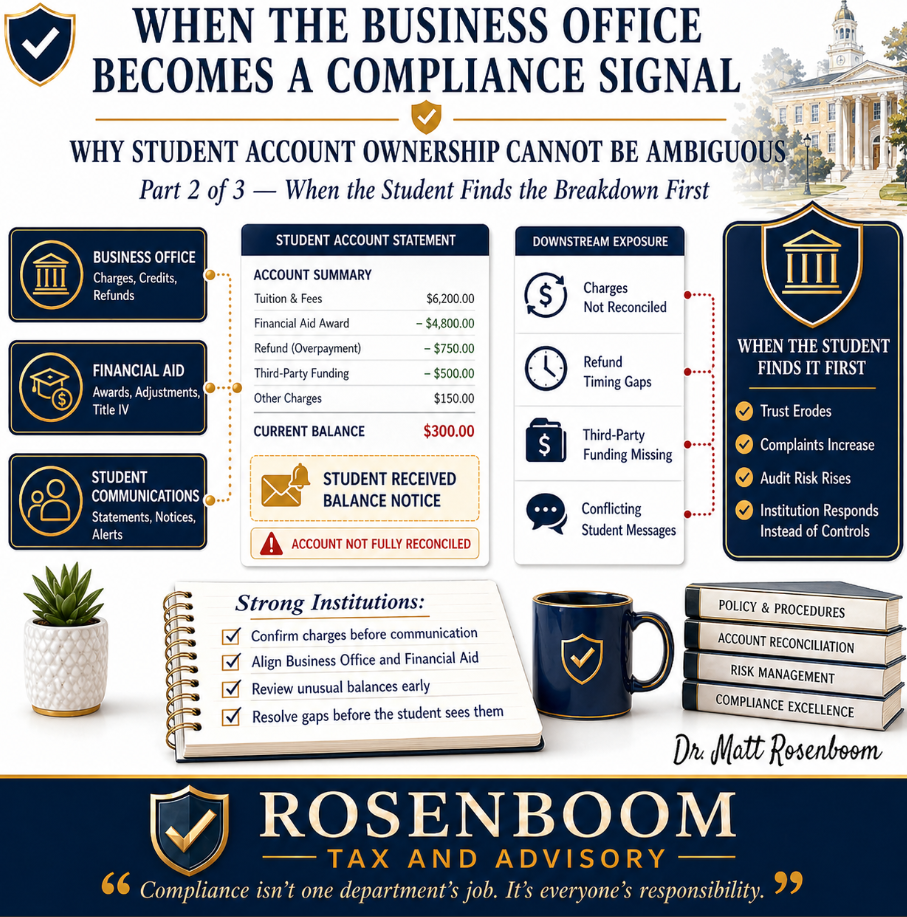
When the Business Office Becomes a Compliance Signal Why Student Account Ownership Cannot Be Ambiguous: When the Student Finds the Breakdown First
When charges, credits, refunds, third-party payments, and Title IV aid do not reconcile before a student receives a balance communication, the issue is no longer just an internal ledger problem. It becomes institutional evidence. This post examines how unclear Business Office ownership creates downstream exposure across Financial Aid, Registrar, student communications, and leadership oversight — and why once the student identifies the breakdown first, the institution is no longer managing the risk. It is responding to it.

When the Business Office Becomes a Compliance Signal Why Student Account Ownership Cannot Be Ambiguous
Yesterday’s Business Office reconciliation theme deserves continued focus because student account issues are appearing too often to treat them as isolated accounting problems. When charges, credits, refunds, third-party payments, and Title IV aid do not reconcile before students receive balance communications, the ledger becomes evidence of institutional risk. This post examines why Financial Aid does not manage the Business Office, why ownership must be clearly defined, and why strong reconciliation is a leadership, compliance, and student trust issue.
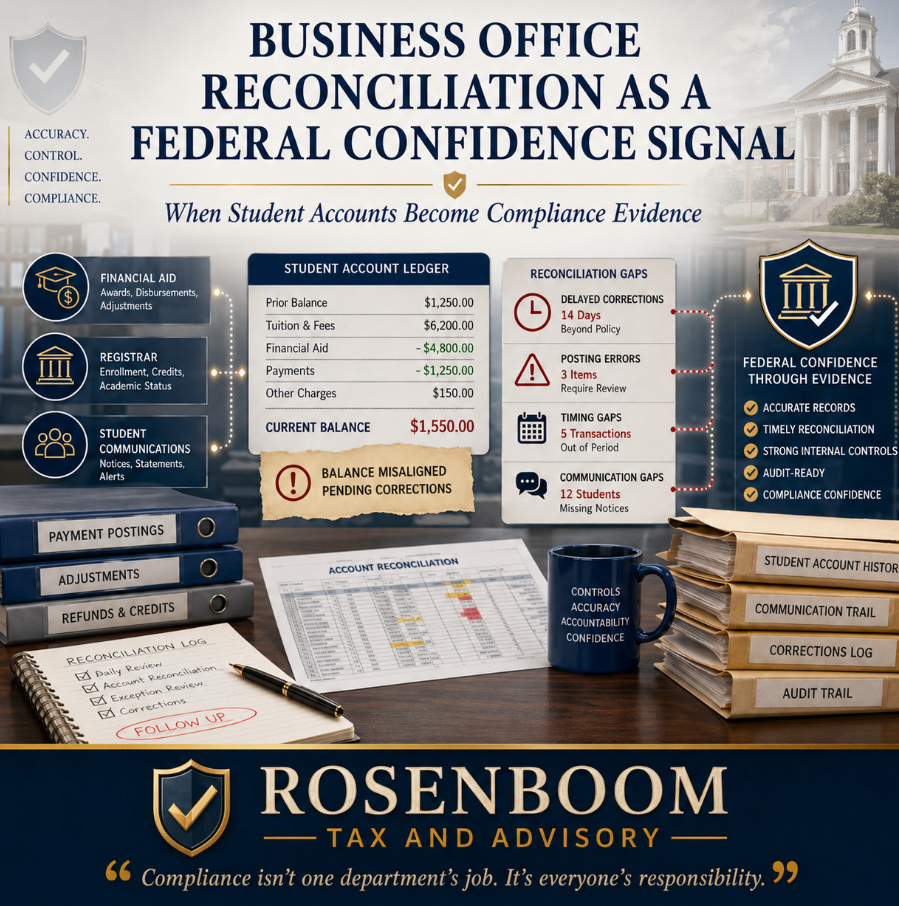
Business Office Reconciliation as a Federal Confidence Signal When Student Accounts Become Compliance Evidence
Business Office reconciliation is more than accounting cleanup — it is evidence of institutional control. When delayed corrections, posting errors, unresolved balances, and inconsistent student communications are not aligned across Business Office, Financial Aid, Registrar, and student support workflows, the institution risks creating multiple versions of the truth. Strong reconciliation signals federal confidence because it shows that the institution can maintain accurate records, timely corrections, and consistent communication before student account issues become findings, complaints, or compliance exposure.